I've offered my thoughts long-form before about the development of digital computing from mainframes to personal computers to networking to mobile devices. In short, I advocate the perspective that the Wintel duopoly of the 1990s peak of the personal computing era was extremely rare, rather than the norm for technological development, and that we are currently approaching the peak of the mobile era, rather than just entering its initial stages.
This puts me at odds with analysts like Reggie Middleton and Henry Blodget, both of whom subscribe more to the model that technology tends to standardize around one company, and the New Microsoft is Google.
Well for a couple of days I've been thinking about how to approach Blodget's hilarious line of 'iPhone dead' articles. The gist of it is that Apple is doomed because Android phones make up half the US market and growing while iPhone is stuck in second place with only 25% marketshare. I've decided to assemble a little quiz for Blodget and analysts like him.
Enjoy!
1. Fill in the blank: In what year did the Mac’s marketshare fall below 25%?
A: It’s a trick question! Macintosh computers have never accounted for even one quarter of personal computer sales.
2. True or False: Apple was the biggest loser to the IBM PC Compatible / Wintel.
A: False. Remember Radio Shack’s Tandy? Did you know Commodore’s 64 was the best-selling computer of all time? Atari was an iconic brand. Heck, even IBM (the ‘IBM’ of the IBM PC Compatible) and Compaq (the ‘Compatible’ of the IBM PC Compatible) don’t make personal computers anymore.
3. Word Association: In the 1980s, the GUI (graphical user interface) was
An unserious toy not fit for Real Men / The obvious wave of the future
4. Multiple Choice: The company that best navigated the market changes from personal computing to network computing to mobile computing is
a. Amiga
b. Commodore
c. Radio Shack
d. Gateway
e. Compaq
f. Dell
g. Xerox
h. Netscape
i. America OnLine
j. CompuServe
k. Prodigy
l. Lucent
m. Novell
n. Lotus
o. WordPerfect
p. Broderbund
q. Research in Motion
r. Nokia
s. Motorola
t. Palm
u. Napster
v. Real
w. Pets.com
x. GeoCities.com
y. Flooz.com
z. Apple
5. Essay question: In five paragraphs, explain how licensing ‘the Mac’ to Compaq, IBM, Gateway, Dell, HP, or other OEMs would have prevented Microsoft from using bundling and exclusivity deals to guide the transition of IBM PC Compatibles from MS-DOS to Windows, creating the ‘Wintel’ juggernaut of the 1990s.
* Extra Credit: Explain how Apple would be better off today if it had spent the 1990s copying Microsoft's business model instead of investing in technologies like QuickTime and Newton.


4/22/2011
midwesterners for manning
So I haven't been able to sleep through the storm this morning. Maybe I'm excited to go home for Easter.
For whatever reason, I've decided to put down my two cents on the government's move of Pfc. Bradley Manning from Quantico to Leavenworth. For most folks, that's like the middle of nowhere. But I happen to be from a few miles east of there! So I put together a Facebook page and attached this description. If I've done this right, you can even click the Facebook link right here to like it.
With the government’s surprise announcement in April of 2011 that Private First Class Bradley Manning would be transferred from Marine Corps Base Quantico to the Army’s Fort Leavenworth, you may be wondering, where the heck is Fort Leavenworth? For the 99% of the population that doesn’t live in the Kansas City metropolitan area, here’s a brief primer on the military assets in the nation’s midsection.
Scattered around the region are a couple of army ammunition plants, underground storage facilities courtesy of various limestone mines and caves, the old Richards-Gebaur Air Force Base, and Honeywell’s nuclear weapons plant. The major military bases are Whiteman Air Force Base and Fort Leavenworth. Whiteman, a little over an hour east of the KC area, is home to one of the world’s most unique military assets – the fleet of B-2 stealth bombers. On the Kansas side, Leavenworth (also the town’s name), in the northwest corner of the KC area, is the oldest Army post west of the Mississippi River. It serves as one of the Army’s most important training facilities.
But this page isn’t about these installations. This is about a particular human being, raising awareness of his circumstances.
You see, Leavenworth is also home to THE federal prison, the prison of prisons, the Place To Be. Sure, there are infamous prisons like Alcatraz, historic prisons like la Bastille Saint-Antoine, and the superduperultravaluemealmax security facilities that have sprouted all over the country. But if you have been a VIP of the United States Federal Government, you have paid a visit to Leavenworth. (Technical note: there are several separate correctional facilities in the Leavenworth area, so if you are ever writing to or visiting someone, make sure you know exactly where they are, but collectively, it’s easiest to simply refer to them all as ‘Leavenworth’).
Naturally, surprise announcements can cause worry and concern, but two key things about Leavenworth do not need to cause alarm. First, it’s true that this relocation moves Manning away from his attorney and the nation’s capital. But Leavenworth isn’t in the middle of nowhere isolated from the rest of the world. It’s actually closer to a major civilian airport than Quantico. Second, Leavenworth is a major destination for military and civilian prisoners. Places like Quantico and Fort Knox are for lesser sentences of military personnel, and on the civilian side, for much of the 20th century, there were few other United States Penitentiaries of note. (Another technical note: in 2005, the civilian federal prison system expanded and reorganized, building larger maximum security facilities and changing United States Penitentiary, Leavenworth to a medium security installation, ending the prison’s century long role as the largest maximum security prison run by the federal government. The United States Disciplinary Barracks remains the military’s sole maximum security facility.)
In other words, the military has taken now 23 year old Bradley Manning out of the purgatory of indefinite detention amongst run of the mill detainees to move him to the place of the federal government’s worst offenders.
Now, I don’t know whether Manning is ‘guilty’ or ‘innocent’ – I don’t even understand exactly what laws the government claims have been broken. As of the time of this transfer, the government hasn’t even started prosecuting him yet, even though he has been imprisoned since May of 2010. What I do know is that every American citizen, every human being, deserves a few basic rights:
1. Due process
2. A speedy trial
3. Humane treatment
4. Protection from cruel and unusual punishment
5. Access to visitors, including legal counsel, friends, and international observers
6. Equal protection under the law
I also know that information about the activities of our government belongs to We the People, not to our employees in Washington. After all, we don’t imprison Daniel Ellsberg, we celebrate him. The government acted so heinously in the Ellsberg case back in the 1970s that the federal judge hearing the trial dismissed all the charges against the man who leaked what we call the Pentagon Papers.
These principles form the bedrock of our justice system, of our way of life, and not just in DC. We Midwesterners happen to believe in them, too.
Thanks for sharing this page with your family, friends, neighbors, colleagues, and elected representatives.
(Note: This summary was compiled by a civilian (me) with no detailed knowledge of either the military or civilian correctional systems. If you have expertise in editing this to be more precise, please feel free to share!)
For more info about the ongoing treatment of Manning, see this website or this one.
For whatever reason, I've decided to put down my two cents on the government's move of Pfc. Bradley Manning from Quantico to Leavenworth. For most folks, that's like the middle of nowhere. But I happen to be from a few miles east of there! So I put together a Facebook page and attached this description. If I've done this right, you can even click the Facebook link right here to like it.
With the government’s surprise announcement in April of 2011 that Private First Class Bradley Manning would be transferred from Marine Corps Base Quantico to the Army’s Fort Leavenworth, you may be wondering, where the heck is Fort Leavenworth? For the 99% of the population that doesn’t live in the Kansas City metropolitan area, here’s a brief primer on the military assets in the nation’s midsection.
Scattered around the region are a couple of army ammunition plants, underground storage facilities courtesy of various limestone mines and caves, the old Richards-Gebaur Air Force Base, and Honeywell’s nuclear weapons plant. The major military bases are Whiteman Air Force Base and Fort Leavenworth. Whiteman, a little over an hour east of the KC area, is home to one of the world’s most unique military assets – the fleet of B-2 stealth bombers. On the Kansas side, Leavenworth (also the town’s name), in the northwest corner of the KC area, is the oldest Army post west of the Mississippi River. It serves as one of the Army’s most important training facilities.
But this page isn’t about these installations. This is about a particular human being, raising awareness of his circumstances.
You see, Leavenworth is also home to THE federal prison, the prison of prisons, the Place To Be. Sure, there are infamous prisons like Alcatraz, historic prisons like la Bastille Saint-Antoine, and the superduperultravaluemealmax security facilities that have sprouted all over the country. But if you have been a VIP of the United States Federal Government, you have paid a visit to Leavenworth. (Technical note: there are several separate correctional facilities in the Leavenworth area, so if you are ever writing to or visiting someone, make sure you know exactly where they are, but collectively, it’s easiest to simply refer to them all as ‘Leavenworth’).
Naturally, surprise announcements can cause worry and concern, but two key things about Leavenworth do not need to cause alarm. First, it’s true that this relocation moves Manning away from his attorney and the nation’s capital. But Leavenworth isn’t in the middle of nowhere isolated from the rest of the world. It’s actually closer to a major civilian airport than Quantico. Second, Leavenworth is a major destination for military and civilian prisoners. Places like Quantico and Fort Knox are for lesser sentences of military personnel, and on the civilian side, for much of the 20th century, there were few other United States Penitentiaries of note. (Another technical note: in 2005, the civilian federal prison system expanded and reorganized, building larger maximum security facilities and changing United States Penitentiary, Leavenworth to a medium security installation, ending the prison’s century long role as the largest maximum security prison run by the federal government. The United States Disciplinary Barracks remains the military’s sole maximum security facility.)
In other words, the military has taken now 23 year old Bradley Manning out of the purgatory of indefinite detention amongst run of the mill detainees to move him to the place of the federal government’s worst offenders.
Now, I don’t know whether Manning is ‘guilty’ or ‘innocent’ – I don’t even understand exactly what laws the government claims have been broken. As of the time of this transfer, the government hasn’t even started prosecuting him yet, even though he has been imprisoned since May of 2010. What I do know is that every American citizen, every human being, deserves a few basic rights:
1. Due process
2. A speedy trial
3. Humane treatment
4. Protection from cruel and unusual punishment
5. Access to visitors, including legal counsel, friends, and international observers
6. Equal protection under the law
I also know that information about the activities of our government belongs to We the People, not to our employees in Washington. After all, we don’t imprison Daniel Ellsberg, we celebrate him. The government acted so heinously in the Ellsberg case back in the 1970s that the federal judge hearing the trial dismissed all the charges against the man who leaked what we call the Pentagon Papers.
These principles form the bedrock of our justice system, of our way of life, and not just in DC. We Midwesterners happen to believe in them, too.
Thanks for sharing this page with your family, friends, neighbors, colleagues, and elected representatives.
(Note: This summary was compiled by a civilian (me) with no detailed knowledge of either the military or civilian correctional systems. If you have expertise in editing this to be more precise, please feel free to share!)
For more info about the ongoing treatment of Manning, see this website or this one.
4/21/2011
movie shocker
from moviefone.com:


I don't know if that's worth driving all the way to south county to see. None of the theaters around here are screening it. They're all excited for Kiera.


I don't know if that's worth driving all the way to south county to see. None of the theaters around here are screening it. They're all excited for Kiera.
4/19/2011
pundit4sale
(P) Something that has fascinated me for several years now is how easily some Democratic pundits seem to shift their principles based upon how the wind blows from party leaders. In the short term, it does provide them significant cover in that it is difficult to discern whether they're bought off or honestly believe what they're blathering. But over time, the only value added Dems bring to the equation is inhabiting the reality-based world, in being interested in doing what works.
It's utter nonsense like this spewed by Matthew Yglesias last week - on a Think Progress blog, no less - that starts warranting comparisons to folks like Rush Limbaugh and Bill O'Reilly and Michelle Malkin. Yglesias is actively proposing that powerful people should be above the law. That's a direct assault on the Constitution, not to mention a market-based economy.
So here's the question. Is Yglesias bought and paid for, knowing that the rule of law is a good thing but being willing to shill for criminals nonetheless? Or does he honestly believe that poor people should go to prison for petty crimes while the rich and powerful should maintain their liberty no matter how heinous the consequences of their actions?
I'm obviously a little partial to the Heartland, but the one-two transpartisan punch of Bill Black at UMKC and Tom Hoenig at the KCFRB over the past couple years has been much more interesting than most of the 'liberal' commentary from Inside the Beltway about how we need to Protect the Financial Fraudsters for the Good of us All.
I eagerly anticipate wittiness from Yglesias in favor of the rule of law. Oh wait, just look to the Bush years.
Like this commentary on Attorney General Mukasey.
Or this one on Bush lawbreaking more generally.
Black's response is worth reading in full. And here is the underlying New York Times article from Gretchen Morgenson and Louise Story that set off Yglesias' defense of our rotten system. By the way, how's that for turnabout? The corporate media runs a big story highlighting a major problem, and the 'liberal' blogger Yglesias defends the status quo!
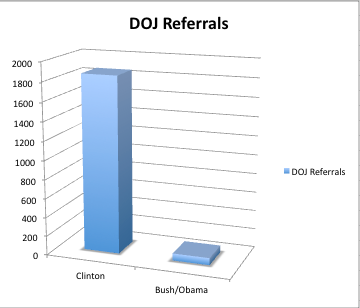
This is also a good place to tie in some commentary from Barry Ritholtz about another NYT article - yes, that's two positive references from me regarding the Times in the same post! Even as the overall US prison population has exploded, the Bush and Obama Justice Departments radically reduced annual referrals of white collar crimes for prosecution. You know, despite the mid-90s having no systemic domestic financial collapse, while a decade plus later, we confront Armageddon that Requires us to Give Rich People Money.
It's utter nonsense like this spewed by Matthew Yglesias last week - on a Think Progress blog, no less - that starts warranting comparisons to folks like Rush Limbaugh and Bill O'Reilly and Michelle Malkin. Yglesias is actively proposing that powerful people should be above the law. That's a direct assault on the Constitution, not to mention a market-based economy.
So here's the question. Is Yglesias bought and paid for, knowing that the rule of law is a good thing but being willing to shill for criminals nonetheless? Or does he honestly believe that poor people should go to prison for petty crimes while the rich and powerful should maintain their liberty no matter how heinous the consequences of their actions?
I'm obviously a little partial to the Heartland, but the one-two transpartisan punch of Bill Black at UMKC and Tom Hoenig at the KCFRB over the past couple years has been much more interesting than most of the 'liberal' commentary from Inside the Beltway about how we need to Protect the Financial Fraudsters for the Good of us All.
I eagerly anticipate wittiness from Yglesias in favor of the rule of law. Oh wait, just look to the Bush years.
Like this commentary on Attorney General Mukasey.
Or this one on Bush lawbreaking more generally.
Black's response is worth reading in full. And here is the underlying New York Times article from Gretchen Morgenson and Louise Story that set off Yglesias' defense of our rotten system. By the way, how's that for turnabout? The corporate media runs a big story highlighting a major problem, and the 'liberal' blogger Yglesias defends the status quo!
This is also a good place to tie in some commentary from Barry Ritholtz about another NYT article - yes, that's two positive references from me regarding the Times in the same post! Even as the overall US prison population has exploded, the Bush and Obama Justice Departments radically reduced annual referrals of white collar crimes for prosecution. You know, despite the mid-90s having no systemic domestic financial collapse, while a decade plus later, we confront Armageddon that Requires us to Give Rich People Money.

4/08/2011
let me see if i have this right
(P) Over the past couple years, Democratic President Barack Obama has argued that the deficit is a serious problem of an urgent nature. To address the presented problem, the Administration has created a fiscal responsibility commission and advocated various approaches like tax cuts, wage freezes, health insurance exchanges, increased out of pocket costs, and so forth. However, the President's budgets haven't actually proposed that revenue equal expenses. After all, the tax cuts, bank bailouts, and military spending have all increased the deficit.
Republican Representative Paul Ryan has also argued that the deficit is a serious problem of an urgent nature. To address the presented problem, he has proposed a budget that advocates various policy options like tax cuts, wage freezes, health insurance exchanges, increased out of pocket costs, and so forth. However, Representative Ryan's budget doesn't actually show how revenue will equal expenses. After all, an actual budget shows not just how much revenue and expenses are projected, but also, what those sources of revenue and expenses are planned to be.
So, uh, what's this about Moments of Truth and Serious Debate and whatnot?
It sounds like we're not even talking about solutions to the purported problem, let alone exchanging ideas about different kinds of solutions.
Republican Representative Paul Ryan has also argued that the deficit is a serious problem of an urgent nature. To address the presented problem, he has proposed a budget that advocates various policy options like tax cuts, wage freezes, health insurance exchanges, increased out of pocket costs, and so forth. However, Representative Ryan's budget doesn't actually show how revenue will equal expenses. After all, an actual budget shows not just how much revenue and expenses are projected, but also, what those sources of revenue and expenses are planned to be.
So, uh, what's this about Moments of Truth and Serious Debate and whatnot?
It sounds like we're not even talking about solutions to the purported problem, let alone exchanging ideas about different kinds of solutions.
4/05/2011
closet artsy fartsy
So I'm on the mailing list for both the St. Louis Symphony and the Opera Theater of St. Louis. It makes sense in that I have bought tickets to both venues and do happen to reside in St. Louis.
However, no one would mistake me for having any insight whatsoever into orchestral pieces, choral arrangements, or opera productions.
Yesterday this officially got out of hand. I received a pretty fancy full color fold out mailer from the Artistic Director of the Des Moines Metro Opera. I don't take Julie to enough shows within close driving distance. I'm pretty sure I'm not driving hundreds of miles to do so. And if we were to travel, there's a slightly half decent chance it would be to a theatrical production of a certain relative of the Schroeder clan...
However, no one would mistake me for having any insight whatsoever into orchestral pieces, choral arrangements, or opera productions.
Yesterday this officially got out of hand. I received a pretty fancy full color fold out mailer from the Artistic Director of the Des Moines Metro Opera. I don't take Julie to enough shows within close driving distance. I'm pretty sure I'm not driving hundreds of miles to do so. And if we were to travel, there's a slightly half decent chance it would be to a theatrical production of a certain relative of the Schroeder clan...
3/30/2011
here is a riddle
I haven't pondered before. Your friendly state-issued photo driver ID is now demanded for all sorts of nondriving purposes. It can get ya booze and cigarettes. It can prove identity to the Feds, from employment to flying. You can see gory movies and rent porn.
Apparently, though, it's not useful for its most basic purpose: proving identification for driving purposes to the state that issued you the ID.
I say all this because I seem to have temporarily accidentally placed my passport in a clearly defined known unknown nonkinetic position, and I don't wish to cause a squirmish at the DMV 36 hours before I have to have my license renewed.
Hopefully the birth certificate isn't stuck in an open-ended commitment to hiding itself.
P.S. This is why you never wait to the last day to do things. You wait until the next to the last day.
Apparently, though, it's not useful for its most basic purpose: proving identification for driving purposes to the state that issued you the ID.
I say all this because I seem to have temporarily accidentally placed my passport in a clearly defined known unknown nonkinetic position, and I don't wish to cause a squirmish at the DMV 36 hours before I have to have my license renewed.
Hopefully the birth certificate isn't stuck in an open-ended commitment to hiding itself.
P.S. This is why you never wait to the last day to do things. You wait until the next to the last day.
3/15/2011
budgeting post script
Time to whip out the Excel charting function one more time.
Apparently, according to Reuters, top Federal Reserve official Bill Dudley was trying to relate to the common man. I suppose he gets props for effort; at least he mentioned something the average American has heard of in a question and answer session that involved more questioning than stenography.
Answer:
Now, there are a number of interesting questions that might elicit such a response. Something about technology, or innovation, or business strategy, or upsetting Reggie Middleton, or when your real question is censored so all you can ask is Mac or PC.
However, here's the actual Question to which Dudley responded:
So, a questioner asks about this part of the budget (food):

And he answered with this (computers):
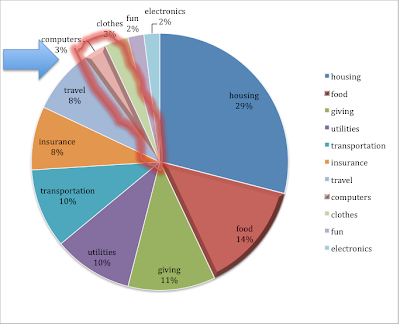
What a perfect illustration of how people ask questions about the important things and our leaders talk about the trivial items. And of course, my personal budget probably puts more emphasis on computing than the average household budget.
Keep that in mind the next time some Important Serious Person says they can balance the budget (or any budget, for that matter). It's really not that complicated. Individual households need decent wages and affordable housing, food, healthcare, education, transportation, and energy. Federal and state governments need some combination of increased taxes on the wealthy and reduced spending on the military, financial industry, fossil fuels, prisons, agribusiness, and healthcare. The final combination of those options is determined by the particular political economy we wish to deliver; there's no one 'right' solution to fiscal responsibility.
But talking about much else, from iPads to public broadcasting, from the NEA to the NEA, is a combination of ignorance and malice, varying in relative proportion from pundit to pundit.
By the way, did you notice the typo in that Reuters quote? I don't know how English teachers can possibly compete for students when the corporate media itself has been busy dismantling all writing standards from ethics to proofreading. Reuters is one of the Good Guys of our traditional media outlets, and it appears they pay about as much attention to an article as I do to a blog post.
Maybe they'd have more advertising dollars and readers if the media had spent more time the past couple decades making our leaders answer serious questions with serious answers.
Apparently, according to Reuters, top Federal Reserve official Bill Dudley was trying to relate to the common man. I suppose he gets props for effort; at least he mentioned something the average American has heard of in a question and answer session that involved more questioning than stenography.
Answer:
"Today you can buy an iPad 2 that costs the same as an iPad 1 that is twice as powerful," he said referring to Apple Inc's (AAPL.O) latest handheld tablet computer hitting stories on Friday.
"You have to look at the prices of all things," he said.
Now, there are a number of interesting questions that might elicit such a response. Something about technology, or innovation, or business strategy, or upsetting Reggie Middleton, or when your real question is censored so all you can ask is Mac or PC.
However, here's the actual Question to which Dudley responded:
But in Queens, New York, on Friday, William Dudley was bombarded with questions about food inflation, and his attempt to put rising commodity prices into a broader economic context only made things worse.
"When was the last time, sir, that you went grocery shopping?" one audience member asked.
So, a questioner asks about this part of the budget (food):

And he answered with this (computers):

What a perfect illustration of how people ask questions about the important things and our leaders talk about the trivial items. And of course, my personal budget probably puts more emphasis on computing than the average household budget.
Keep that in mind the next time some Important Serious Person says they can balance the budget (or any budget, for that matter). It's really not that complicated. Individual households need decent wages and affordable housing, food, healthcare, education, transportation, and energy. Federal and state governments need some combination of increased taxes on the wealthy and reduced spending on the military, financial industry, fossil fuels, prisons, agribusiness, and healthcare. The final combination of those options is determined by the particular political economy we wish to deliver; there's no one 'right' solution to fiscal responsibility.
But talking about much else, from iPads to public broadcasting, from the NEA to the NEA, is a combination of ignorance and malice, varying in relative proportion from pundit to pundit.
By the way, did you notice the typo in that Reuters quote? I don't know how English teachers can possibly compete for students when the corporate media itself has been busy dismantling all writing standards from ethics to proofreading. Reuters is one of the Good Guys of our traditional media outlets, and it appears they pay about as much attention to an article as I do to a blog post.
Maybe they'd have more advertising dollars and readers if the media had spent more time the past couple decades making our leaders answer serious questions with serious answers.
3/10/2011
3/02/2011
the superiority of social insurance
(P) So I'm testing out the online reporting system for medical information at my work. It's pretty standard and works reasonably well. They brag about how it saves you having to fill out 27 pieces of paper every year.
Whoopdeedoo.
This processs reminds me of one of the basic failures of private health insurance: a fragmented system is extremely inefficient. Take identification. How do insurance companies identify you?
The answer, of course, is that they don't. They panic and run to the obvious solution - socialized medicine [cue scary music].
Here's my challenge of the day for those who believe government should not provide basic social insurance coverages, like health insurance and unemployment insurance. If the government is so inefficient, why do private companies use ID numbers created by the Social Security Administration?
Whoopdeedoo.
This processs reminds me of one of the basic failures of private health insurance: a fragmented system is extremely inefficient. Take identification. How do insurance companies identify you?
The answer, of course, is that they don't. They panic and run to the obvious solution - socialized medicine [cue scary music].
Here's my challenge of the day for those who believe government should not provide basic social insurance coverages, like health insurance and unemployment insurance. If the government is so inefficient, why do private companies use ID numbers created by the Social Security Administration?
Subscribe to:
Posts (Atom)