(PR) Uh oh, I'm ranting about politics...
I obviously haven't been paying much attention because I didn't realize the Clinton blowjob of the early 21st century was an ongoing matter. But apparently, former Senator, Vice Presidential nominee, and Presidential candidate John Edwards has been under an actual, real-life, full blown Department of Justice criminal investigation because he did something absolutely no politician ever does, try to portray a false public narrative about himself that doesn't match his actual nature.
I mean, thank goodness our political leaders (and heck, our business leaders, too, for that matter) are such paragons of virtue and family values.
But what intrigues me most is that the Obama Administration isn't happy with the Usual Punishment* for Being Caught: expulsion from the club (publicly). They actually want a felony conviction.
Quick, name the 10 most important people the Obama Administration has prosecuted.
Okay, I'll give you multiple choice:
a. George Bush
b. Dick Cheney
c. Condoleeza Rice
d. Donald Rumsfeld
e. Alberto Gonzalez
f. ...uh, this might take awhile...
It's almost comical. I only met John Edwards once (I was a pretty big fan back in 2007 of his candidacy). He struck me in person to actually be a lot like his reputation: he felt like a rich, sleezy used car salesman. I don't invite used car salesmen to my birthday parties. I don't go to movies with them. But you know what, I bought my car from one. They serve a purpose. Where the purpose overlaps with your purpose, they are valuable partners.
I ain't lookin' for a saint; and heck, even saints are sinners.
John Edwards made his cheesy sloganeering about poverty. Even today, you can say the phrase two Americas and largely evoke a pretty coherent narrative that Edwards was telling. Now, he's living the two Americas. The problem with our two-tiered justice system isn't that people down on their luck don't break the law. The problem is when the full weight of the law is selectively administered.
If I knew him well enough to call him John, I'd be in position to talk about how his life has completely fallen apart. I'd wonder what Cate, his eldest daughter the same age as me, is going through. But I don't know the family, and like any other family with moral, and now legal, complications, their challenges are for them to face, to decide how they want to come out the other end. His sin is against his wife, his kids, his family, his faith.
What I do know is that this has a chance to remind us what the rule of law means. It means no one is above it. All are equal under it. Technicalities are all the law is. Create exceptions, and what you've got is two Americas.
* of course, even being caught doesn't necessarily do it. Heck, people as varied as Rush Limbaugh and Tim Geithner have broken the law. And no one in the world avails themselves of more drugs and prostitutes than Manhattan and DC.
Showing posts with label edwards. Show all posts
Showing posts with label edwards. Show all posts
6/03/2011


8/10/2008
sadness
I wanted to link to John's statement on his betrayal of Elizabeth back in 2006. It's not particularly lengthy or Earth shattering. It's John being John. You can pretty much read it however you want. What happened is pretty straightforward. He fucked somebody without the approval of his wife (er, uh, had a 'liaison with another woman').
I personally don't think the details are very important. That's between he and Elizabeth. Cheating is both rampant and unacceptable. Dealing with that contradiction is for a different post.
As someone who doesn't know the Edwards family personally, what I have found most interesting is how intense the scrutiny has been by others who also don't know the family. In times like this, I very much urge inner reflection on the fact that we are all flawed, we all sin. We'll never know the sincerity of famous people's requests for forgiveness.
But we can know the sincerity of our own requests. Who do we need to apologize to? Who do we need forgiveness from?
I personally don't think the details are very important. That's between he and Elizabeth. Cheating is both rampant and unacceptable. Dealing with that contradiction is for a different post.
As someone who doesn't know the Edwards family personally, what I have found most interesting is how intense the scrutiny has been by others who also don't know the family. In times like this, I very much urge inner reflection on the fact that we are all flawed, we all sin. We'll never know the sincerity of famous people's requests for forgiveness.
But we can know the sincerity of our own requests. Who do we need to apologize to? Who do we need forgiveness from?
6/26/2008
people are pissed
(P) And it's a good thing! Nevermind what the candidate of change says. It looks like there has been such massive contempt for the outright corruption and unconstitutionality of the FISA changes from Americans of all political stripes that we might have succeeded again in delaying two very simple, very bad ideas: broad warrantless searches by a government that wouldn't even have to make its reports public, and broad legal immunity for corporations that knowingly broke the law, repeatedly, over a number of years.
There's not much more to add about Senator Obama's stance. He's wrong on the issue, he knows he's wrong on the issue, he knows we know he's wrong on the issue, and he knows we know he has purposefully altered his stance from back when Senator Dodd, former Senator Edwards, Senator Clinton, and others were competing with him for the nomination. Either his campaign staff didn't show up for work this week, they think voters are stupid, or they actually favor the unitary executive/corporate authoritarian worldview permeating this bill. None are particularly appealing options to explore from the campaign of the de facto, barring-more-election-theft next president.
So let's talk about the good that is happening. For example, Senator Dodd continues to impress on this issue, proving that a good strategy and being right can produce results. And Senator Feingold continues to prove that one's stature is strengthened, not weakened, by taking strong positions among constituents in a state that's not solidly Democratic like New York, California-or Illinois (apparently 'centrists' and 'moderates' and 'independents', not to mention leftists and libertarians, like leaders who don't sell out to corporate criminals on basic matters of rights and accountability). And Senator Reid came out (was forced?) to publicly announce he wouldn't support the bill. Even Speaker Pelosi, after ramming the bill through the House, was forced to publicly acknowledge that perhaps spending some time debating the bill (in the Senate) would be a good thing after all.
Who knows, maybe we'll get more speeches like this one from Senator Dodd from other Democrats in the future, on this issue or something else. Click on the link, it's worth listening to. Perhaps the most exciting and refreshing speech since Edwards' talk at the winter DNC meeting last year (warning: it's a tad longer than that speech).
Of course, Senator Obama, it is never too late to change your stance to the right one. Abandon the language of fear and deception, the very rejection of which you are basing your campaign on. Americans know national security is important. We also know this bill has nothing to do with national security. Give us the benefit of the doubt; trust us to handle the Constitution the way you trusted us regarding your pastor. You just might be pleasantly surprised.
There's not much more to add about Senator Obama's stance. He's wrong on the issue, he knows he's wrong on the issue, he knows we know he's wrong on the issue, and he knows we know he has purposefully altered his stance from back when Senator Dodd, former Senator Edwards, Senator Clinton, and others were competing with him for the nomination. Either his campaign staff didn't show up for work this week, they think voters are stupid, or they actually favor the unitary executive/corporate authoritarian worldview permeating this bill. None are particularly appealing options to explore from the campaign of the de facto, barring-more-election-theft next president.
So let's talk about the good that is happening. For example, Senator Dodd continues to impress on this issue, proving that a good strategy and being right can produce results. And Senator Feingold continues to prove that one's stature is strengthened, not weakened, by taking strong positions among constituents in a state that's not solidly Democratic like New York, California-or Illinois (apparently 'centrists' and 'moderates' and 'independents', not to mention leftists and libertarians, like leaders who don't sell out to corporate criminals on basic matters of rights and accountability). And Senator Reid came out (was forced?) to publicly announce he wouldn't support the bill. Even Speaker Pelosi, after ramming the bill through the House, was forced to publicly acknowledge that perhaps spending some time debating the bill (in the Senate) would be a good thing after all.
Who knows, maybe we'll get more speeches like this one from Senator Dodd from other Democrats in the future, on this issue or something else. Click on the link, it's worth listening to. Perhaps the most exciting and refreshing speech since Edwards' talk at the winter DNC meeting last year (warning: it's a tad longer than that speech).
Of course, Senator Obama, it is never too late to change your stance to the right one. Abandon the language of fear and deception, the very rejection of which you are basing your campaign on. Americans know national security is important. We also know this bill has nothing to do with national security. Give us the benefit of the doubt; trust us to handle the Constitution the way you trusted us regarding your pastor. You just might be pleasantly surprised.
1/29/2008
go john
(P) I'm not really the cheerleader type. I'd never be one of those people asked to warm up the crowd at a pep rally or before a speech. But hey, that doesn't mean I don't get excited. So since we're next (finally), I thought I'd give a try at being concise in my thoughts leading up to Feb 5.
In the spirit of brevity, I am going to keep this to three reasons. Here goes.
1) Edwards has been out ahead on the issues. I like his detail and his timeliness. The issues seem to matter with his campaign, he's talking about the right issues, and it seems like the advisers around him are the most open to the full range of policy options. Poverty, healthcare, the environment, trade policy, minimum wage, Iraq, torture, and so forth. The only candidate who seems able to use the word accountability to modify the word corporate. In a national landscape so thoroughly dominated by corporate interests, a willingness to call the problem by its name is greatly appreciated. And deserving of a vote.
2) Edwards has been driving the debate. Perhaps this has special appeal to me as a debater and debate coach. The way Edwards has influenced the language and proposals of the other candidates suggests to me a president who will take advantage of the opportunity to guide the national discourse in important new directions. Even if he doesn't win the nomination, his very presence and the clarity of his more populist message has had an impact on whatever platform the ultimate nominee assembles.
3) The Edwards candidacy represents a different approach within the Democratic party. I think it's time to have a Democrat who hasn't been in Washington the past few years, who hasn't been within the party establishment. In fact, Edwards had a chance to be the establishment candidate. He was, after all, the more energetic half of Kerry/Edwards 04. Yet, he left DC and has been out doing things on poverty and education and healthcare and such. Instead of being Kerry in 2008, he's actually Dean in 2008, but, I think, with a message that's even more openly populist.
There are also a few tactical things I thought I'd point out.
1) None of the candidates are 'anti-war'. It's unfortunate, but all three seem to have bought into the basic premise that we need to spend hundreds of billions of dollars a year on military activities. While Clinton is most directly hawkish, Obama is clearly under a lot of influence in the Senate. In the past three years, he hasn't been a leader on stopping the war, he hasn't supported censure or impeachment efforts, he hasn't been able to stop torture or the suspension of habeus corpus or anything else the Bush Administration has been up to. He supported primary candidates in 2006 that were more pro-war than the challengers they were running against. He continues to talk about increasing the size of the military. And Obama won't promise that US troops will leave Iraq before the end of his first term. What could be a powerful antiwar campaign of Obama in 2002 is reduced to a hope that Obama in 2008 wouldn't be quite as bad as Clinton. Or Lieberman (whom Obama endorsed in 2006 over anti-war challenger Lamont).
2) If you are not wanting Clinton to win, or you don't like the idea of backing someone who's a longshot to win, the primary process is different than the general election. The Democratic party has a proportional representation system, not a winner take all system. If you lean Edwards, you don't need to feel like you have to vote for Clinton or Obama in order to make your vote count. Edwards can pick up delegates even if he finishes third in a state. Delegates are how the party platform and the nominee will get decided in Denver.
3) It is not bad to have a lengthy nomination process. In fact, quite the opposite. It gives the candidates longer to talk to the public, and it allow them more time to develop their specific policy positions. A rush to crown a nominee, followed by months of relative media silence, is much less effective. Competition is good.
4) Vote :) Vote for Clinton. Vote for Obama. Vote for Edwards. Write in Kucinich. Do whatever. But whatever you do, go to the polls on February 5th. The best way to influence all politicians is to show them that the citizenry is energized, paying attention, and willing to take action.
In the spirit of brevity, I am going to keep this to three reasons. Here goes.
1) Edwards has been out ahead on the issues. I like his detail and his timeliness. The issues seem to matter with his campaign, he's talking about the right issues, and it seems like the advisers around him are the most open to the full range of policy options. Poverty, healthcare, the environment, trade policy, minimum wage, Iraq, torture, and so forth. The only candidate who seems able to use the word accountability to modify the word corporate. In a national landscape so thoroughly dominated by corporate interests, a willingness to call the problem by its name is greatly appreciated. And deserving of a vote.
2) Edwards has been driving the debate. Perhaps this has special appeal to me as a debater and debate coach. The way Edwards has influenced the language and proposals of the other candidates suggests to me a president who will take advantage of the opportunity to guide the national discourse in important new directions. Even if he doesn't win the nomination, his very presence and the clarity of his more populist message has had an impact on whatever platform the ultimate nominee assembles.
3) The Edwards candidacy represents a different approach within the Democratic party. I think it's time to have a Democrat who hasn't been in Washington the past few years, who hasn't been within the party establishment. In fact, Edwards had a chance to be the establishment candidate. He was, after all, the more energetic half of Kerry/Edwards 04. Yet, he left DC and has been out doing things on poverty and education and healthcare and such. Instead of being Kerry in 2008, he's actually Dean in 2008, but, I think, with a message that's even more openly populist.
There are also a few tactical things I thought I'd point out.
1) None of the candidates are 'anti-war'. It's unfortunate, but all three seem to have bought into the basic premise that we need to spend hundreds of billions of dollars a year on military activities. While Clinton is most directly hawkish, Obama is clearly under a lot of influence in the Senate. In the past three years, he hasn't been a leader on stopping the war, he hasn't supported censure or impeachment efforts, he hasn't been able to stop torture or the suspension of habeus corpus or anything else the Bush Administration has been up to. He supported primary candidates in 2006 that were more pro-war than the challengers they were running against. He continues to talk about increasing the size of the military. And Obama won't promise that US troops will leave Iraq before the end of his first term. What could be a powerful antiwar campaign of Obama in 2002 is reduced to a hope that Obama in 2008 wouldn't be quite as bad as Clinton. Or Lieberman (whom Obama endorsed in 2006 over anti-war challenger Lamont).
2) If you are not wanting Clinton to win, or you don't like the idea of backing someone who's a longshot to win, the primary process is different than the general election. The Democratic party has a proportional representation system, not a winner take all system. If you lean Edwards, you don't need to feel like you have to vote for Clinton or Obama in order to make your vote count. Edwards can pick up delegates even if he finishes third in a state. Delegates are how the party platform and the nominee will get decided in Denver.
3) It is not bad to have a lengthy nomination process. In fact, quite the opposite. It gives the candidates longer to talk to the public, and it allow them more time to develop their specific policy positions. A rush to crown a nominee, followed by months of relative media silence, is much less effective. Competition is good.
4) Vote :) Vote for Clinton. Vote for Obama. Vote for Edwards. Write in Kucinich. Do whatever. But whatever you do, go to the polls on February 5th. The best way to influence all politicians is to show them that the citizenry is energized, paying attention, and willing to take action.
1/20/2008
highs and lows
Sometimes politics and economics are related, but these two things really have nothing to do with each other except that they've both happened recently and are worth commenting on.
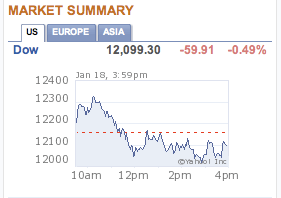
Last year, I took a second to mention the Dow's breaking the 14,000 barrier in July. So I suppose at this time it is worthwhile to emphasize the other half of that message. It's ok for long term investors if stocks perform poorly in the short term. Don't panic! In fact, when in a period of decline, that's the best time to dump additional money for the long haul into equities. Just make sure it's really for next decade, not next week. Your emergency fund should never leave your savings account.
How much has the market (or more accurately, several markets) crashed? From breaking 14,000 last July, we're back under 13,000 now, almost below 12,000. In fact, what's happened the last few weeks is the largest decline in the history of the DJIA. By comparison, the crash of 1987 was less than a thousand points. Since then, the Dow has risen by almost exactly 10,000. In other words, a hypothetical investment in the 30 companies would have sextupled in the 20 years from Black Monday to LameduckW. Okay, LameduckW may not be the word historians ultimately use for the markets under Bush, but until they come up with a better name for this crash, that's what I'm calling it. But what if you bought the day before Black Monday? Well, then you'll have to console yourself with only a quadrupling of your money from 1987 to now (unless you got emotional and sold your investment, in which case you had quite the loss).
All of this, if you're like me, screams buy! If a Democratic president enters the White House come January 2009, we are primed for some impressive gains the next few years. Youngun's especially, take advantage.
And one side note. The National Association of Realtors, the lovely lobbying organization designed to market buying and selling houses (as opposed to making sure everyone has housing) and ensuring one of our most regressive tax breaks stays in place, the mortgage interest expense deduction, is running ads advertising a rather misleading website. They make some ridiculous claims about the historical appreciation of houses, and of course, the data they cite is their own historical series survey that you have to buy from them. Obviously, the reason they don't cite the data is because it's based upon the height of the housing bubble, not the long-term historical record that shows houses appreciating about half a percent a year above the inflation rate, much less than the doubling every 10 years they claim (which requires over a 7% annual gain). Plus, of course, these are all gross figures; they are not net of the costs of homeownership. Homeownership is valuable mostly because people like owning their home. Few people treat their homes in the emotionless, rational state necessary to count as an investment.
But what really is offensive about the website is the use of statistics about the distribution of wealth. They accurately point out that homeowners as a group have a much higher net worth than renters. Having a net worth of "46 times that of a renter" is most definitely not a benefit of home ownership, though. It's a benefit of higher wages and a longer working career. In fact, their observation is precisely why we should eliminate the tax breaks for homeowners. People who earn money to buy and sell property obviously want you to think that owning a house is more valuable than renting one. But that doesn't mean it actually is, and it certainly should rouse suspicion and scrutiny when a lobbying organization is making such blatantly misleading statements at a time when the market it represents is in the bust phase of its bubble.
(P) I hadn't originally intended that little disgust with the NAR as a segue from the market's ups and downs to Senator Edwards' ups and downs, but it seems pretty appropriate. I was very excited yesterday to go see John speak at the Carpenter's District Council building. For one thing, I'd driven past it a hundred times, but I'd never been there. It's interesting living in a town that actually still has a union presence. It was also a reminder, that I say only half-jokingly, that lots of white people live in the city, too. It was almost unbelievable, I'd say 3/4 of the people who packed into that meeting hall were older than 40 and white. They still exist!
I really liked his stump speech, and that was really the first time I've been around a large gathering of Edwards supporters. Mostly it's been smaller groups, like what we did at Earth day or greeting him at the National Urban League conference. In my mind, Edwards is saying the right things and has the right approach.
Clearly, though, Nevada did not go very well yesterday for Edwards. It makes me wonder a bit if they started campaigning elsewhere because they knew that was going to happen. With two third place finishes in a row, it's worth asking what is left to get accomplished. While finishing third in the Republican race any given day isn't a big deal, the Democratic side is a little more consolidated at this point. That itself is quite interesting, since the corporate media likes to talk a lot about fractures in the Democratic party when the GOP is really what is splintered at the moment, but that's a slightly different topic.
What stands out to me is that there's no reason not to keep going. For one thing, Clinton has not been able to stake out a majority position, even as she borrows some of the ideas and language from the Edwards and Obama campaigns. She hasn't won a majority of delegates in any state so far (unless you count Michigan, which is actually embarrassing for how few votes she received), and in fact, Edwards beat her, at least in terms of votes, in the Iowa caucus (you don't really know for months the actual delegates each candidate will get). If Nevada is a sign of things to come, then obviously Edwards isn't stealing votes from Obama. If it was an aberration, then it can't be a reason to ask Edwards to leave the race. The longer he's in, the more he has a chance to shape the dialogue and influence the convention. And of course, he just might win a few states.
That leaves me with the most interesting question I have after this weekend. Why do some people want him to drop out? Do they not like his message? Do they think he's preventing Clinton from getting more votes? Do they think he's preventing Obama from getting more votes? Do they not like having a broader field to choose from? Does Edwards' continued presence allow him to raise uncomfortable questions that people in the media or the party don't want asked? If a majority of voters want Clinton or Obama to be their nominee, then I'll respect that. But what I don't understand is telling a guy he needs to drop out after only three states have voted, in one of which he beat Clinton.
I hope Edwards picks up some states in the next few weeks. But I'm quite sure it would beneficial for him to stay in the race through the convention, even if he doesn't win a single state.
Last year, I took a second to mention the Dow's breaking the 14,000 barrier in July. So I suppose at this time it is worthwhile to emphasize the other half of that message. It's ok for long term investors if stocks perform poorly in the short term. Don't panic! In fact, when in a period of decline, that's the best time to dump additional money for the long haul into equities. Just make sure it's really for next decade, not next week. Your emergency fund should never leave your savings account.
How much has the market (or more accurately, several markets) crashed? From breaking 14,000 last July, we're back under 13,000 now, almost below 12,000. In fact, what's happened the last few weeks is the largest decline in the history of the DJIA. By comparison, the crash of 1987 was less than a thousand points. Since then, the Dow has risen by almost exactly 10,000. In other words, a hypothetical investment in the 30 companies would have sextupled in the 20 years from Black Monday to LameduckW. Okay, LameduckW may not be the word historians ultimately use for the markets under Bush, but until they come up with a better name for this crash, that's what I'm calling it. But what if you bought the day before Black Monday? Well, then you'll have to console yourself with only a quadrupling of your money from 1987 to now (unless you got emotional and sold your investment, in which case you had quite the loss).
All of this, if you're like me, screams buy! If a Democratic president enters the White House come January 2009, we are primed for some impressive gains the next few years. Youngun's especially, take advantage.

And one side note. The National Association of Realtors, the lovely lobbying organization designed to market buying and selling houses (as opposed to making sure everyone has housing) and ensuring one of our most regressive tax breaks stays in place, the mortgage interest expense deduction, is running ads advertising a rather misleading website. They make some ridiculous claims about the historical appreciation of houses, and of course, the data they cite is their own historical series survey that you have to buy from them. Obviously, the reason they don't cite the data is because it's based upon the height of the housing bubble, not the long-term historical record that shows houses appreciating about half a percent a year above the inflation rate, much less than the doubling every 10 years they claim (which requires over a 7% annual gain). Plus, of course, these are all gross figures; they are not net of the costs of homeownership. Homeownership is valuable mostly because people like owning their home. Few people treat their homes in the emotionless, rational state necessary to count as an investment.
But what really is offensive about the website is the use of statistics about the distribution of wealth. They accurately point out that homeowners as a group have a much higher net worth than renters. Having a net worth of "46 times that of a renter" is most definitely not a benefit of home ownership, though. It's a benefit of higher wages and a longer working career. In fact, their observation is precisely why we should eliminate the tax breaks for homeowners. People who earn money to buy and sell property obviously want you to think that owning a house is more valuable than renting one. But that doesn't mean it actually is, and it certainly should rouse suspicion and scrutiny when a lobbying organization is making such blatantly misleading statements at a time when the market it represents is in the bust phase of its bubble.
(P) I hadn't originally intended that little disgust with the NAR as a segue from the market's ups and downs to Senator Edwards' ups and downs, but it seems pretty appropriate. I was very excited yesterday to go see John speak at the Carpenter's District Council building. For one thing, I'd driven past it a hundred times, but I'd never been there. It's interesting living in a town that actually still has a union presence. It was also a reminder, that I say only half-jokingly, that lots of white people live in the city, too. It was almost unbelievable, I'd say 3/4 of the people who packed into that meeting hall were older than 40 and white. They still exist!
I really liked his stump speech, and that was really the first time I've been around a large gathering of Edwards supporters. Mostly it's been smaller groups, like what we did at Earth day or greeting him at the National Urban League conference. In my mind, Edwards is saying the right things and has the right approach.
Clearly, though, Nevada did not go very well yesterday for Edwards. It makes me wonder a bit if they started campaigning elsewhere because they knew that was going to happen. With two third place finishes in a row, it's worth asking what is left to get accomplished. While finishing third in the Republican race any given day isn't a big deal, the Democratic side is a little more consolidated at this point. That itself is quite interesting, since the corporate media likes to talk a lot about fractures in the Democratic party when the GOP is really what is splintered at the moment, but that's a slightly different topic.
What stands out to me is that there's no reason not to keep going. For one thing, Clinton has not been able to stake out a majority position, even as she borrows some of the ideas and language from the Edwards and Obama campaigns. She hasn't won a majority of delegates in any state so far (unless you count Michigan, which is actually embarrassing for how few votes she received), and in fact, Edwards beat her, at least in terms of votes, in the Iowa caucus (you don't really know for months the actual delegates each candidate will get). If Nevada is a sign of things to come, then obviously Edwards isn't stealing votes from Obama. If it was an aberration, then it can't be a reason to ask Edwards to leave the race. The longer he's in, the more he has a chance to shape the dialogue and influence the convention. And of course, he just might win a few states.
That leaves me with the most interesting question I have after this weekend. Why do some people want him to drop out? Do they not like his message? Do they think he's preventing Clinton from getting more votes? Do they think he's preventing Obama from getting more votes? Do they not like having a broader field to choose from? Does Edwards' continued presence allow him to raise uncomfortable questions that people in the media or the party don't want asked? If a majority of voters want Clinton or Obama to be their nominee, then I'll respect that. But what I don't understand is telling a guy he needs to drop out after only three states have voted, in one of which he beat Clinton.
I hope Edwards picks up some states in the next few weeks. But I'm quite sure it would beneficial for him to stay in the race through the convention, even if he doesn't win a single state.
1/13/2008
funny to serious
Julie and I went to see the Courthouse Steps with her parents in Florissant this weekend. They're kind of like the Capitol Steps, but a group with a lot of St. Louis-specific stuff. They're lawyers who happen to like to sing about various parody-worthy headlines.
We did dinner beforehand at Hendel's Market. Mmm, pork chops.
(P) So now that it's 2008 and a few of the delegates have actually been chosen by voters (as opposed to the 'superdelegates'), I thought this would be a good time to explore where I'm at. Or maybe I'm just procrastinating on starting the work week.
Basically, I started leaning toward former Senator John Edwards about a year ago, and by now, the leaning's far enough gravity's pretty much taken over. There are a couple of things I really like about what he is doing. First, while he's definitely running to be the Democratic party nominee, he seems to be running purposefully outside the parts of the party tied more to the DLC and corporate interests and DC consultants and so forth. I think this is particularly noteworthy given that the Kerry/Edwards campaign in 2004 very much earned the DLC seal of approval. Edwards used to be a New Democrat; I'm not sure if that makes him an "old" Democrat now. Perhaps, it just makes him a Democrat. He also used to be a Senator. He used to work for Fortress Investment Group, one of those Wall Street hedge funds incorporated in Delaware that incorporated its particular funds in the Cayman Islands for 'tax purposes', ie, tax evasion for the wealthy. He used to support the Iraq war; or, probably more accurately, thought it wasn't important enough to say anything that would upset the party leadership. That stands in stark contrast to positions staked out by a few notable Democrats, such as Al Gore and Barack Obama from outside Washington, or Dennis Kucinich, John Conyers, and the 150-odd politicians inside Washington (from all parties) who voted against the war in 2002. The fact that Senator Edwards chose a strategy of breaking with all this history to try for the nomination in 2008 I appreciate and am very excited about. He's not been in government for years, which in and of itself is a plus for me right now. He's off talking about poverty and economic class and healthcare. Even if everything he would do is wrong, he's talking like a populist. In so doing, he's forcing the whole conversation of the Democratic candidates to change, to deal with what he's talking about.
Which leads to me to the second thing I like. Edwards' stump speeches tend to be a little repetitive; the mill and cleft pallette (palette, pallatt?) stories are older than the lumpy milk in my fridge. But the specific policy positions he has taken are incredibly detailed, especially considering how early he started talking in detail about things like healthcare and the environment. I like the fact that Edwards is substantive enough in the campaign to give you enough that you can disagree with him. The impression Senator Obama leaves sometimes is that of a vagueness where you can see what you want to see; there's nothing to disagree with. Partly that's unfair because he's outlined things in a lot more detail more recently in the campaign process, and earlier in his books. But in a lot of ways, that sounds like how Al Gore's campaign got handled. Dumb everything down, don't talk about the specifics, even (especially?) if you've written books about them. I really think right now what we need is not a progressive to sound like a centrist long enough to get into office and then take the gloves off, as Dick Cheney might say, but rather somebody who's going to talk the talk right now, to lead the national dialogue at a moment when Democrats are getting lots of attention in the corporate media (all efforts to ban Kucinich from the debates aside).
But before I talk too much about Senator Obama, let me address the rest of the field first. I really like Representative Kucinich. He's one of the few national Democrats that seem ready and willing to act independently of the Democratic leadership when he feels it's necessary. He seems to get it on a lot of the issues that are important to me. In some ways he's more liberal/leftist than I, but his independent streak I value highly. He just seems to lack an ability to get people energized on a national level. Perhaps that says more about the Democratic party's nomination process than it does about Kucinich, but nonetheless, I think it's there and it's real. He has the largely thankless task of trying to shape the debate, to raise different issues and paint issues that are raised in different ways, all the while being lambasted by a variety of people who want him to just sit down and shut up. Groupthink is just as dangerous in a political party as any other group.
Governor Richardson and Senator Biden never did much for me. Senator Gravel had his moments, but his positions are just too out of the mainstream on a few issues for me. Senator Dodd is another person that doesn't seem to have much national appeal, but the more I learned about him, the more I liked him. He's practically single-handedly responsible for delaying the incredibly absurd idea of granting immunity to mass criminals. Senator Clinton has too many issues I disagree with her on. She just seems too cozy these days with the kinds of companies that wrote the Medicare bill and the Peru trade pact and control the media. It's also worth noting that as a white male whose relatives have been in the country for centuries, I obviously don't have a personal connection to the possibility that a woman or a hispanic or a black man or the son of an immigrant might win the White House. I understand that that is an important symbol, and that is a very interesting factor in the Democratic race this year.
None of this is to say that I'm deeply opposed to any of the Democratic candidates. In fact, this year is exciting in large part because there's a good chance they should win in November and, whoever the nominee is, it'll be a pretty good one. That gets me back to the former North Carolina Senator. I think we have a chance (again) to not just have a decent president, another Bill Clinton of the 1990s, but to have a president who's going to rewrite the rules in Washington. The chance that I care about isn't to put a Democrat in the White House. I'm pretty disgusted with the Democratic Party, especially senior figures in Washington. 2008 will be even harder than 2004 and 2000 for the Democratic Party to not gain the White House. Short of an actual fascist takeover, a burning of the Capitol, so to speak, Bush will be out of office in 2009 no matter what the Democrats do. What is exciting is the ability to put a really intriguing candidate in the White House, a candidate who spent the campaign telling everybody that when it comes to making policy, the needs of average citizens will count as much as the demands of a few of the country's wealthiest citizens. Edwards is the one driving the populist rhetoric, even to the point of getting Clinton and Obama to adopt some of the same language.
Senator Obama might be the most energizing candidate. He might be something truly special, something different, something that's a notch above most other national Democrats. But I'm just not sold on it. In Obama-speak, I don't believe. And if he's not a new breed of politics, then the stuff I like about Edwards is more than enough to sway my vote. There are three fundamental questions I have. These are serious questions, I'm not just looking to bash the Illinois Senator (quite the contrary, I would be happy to vote for him in November). I would be happier about him, though, if I could get some answers on these.
The first thing that nags at me is his choice on endorsing certain candidates. In races that mattered, at times that mattered, he seems to have thrown in his lot with the DCCC and DSCC and established Washington thinking to the direct detriment of local grass roots efforts for change, perhaps even in conflict with Dean's efforts at the DNC. In fact, if there's one issue Senator Obama stands out the most on nationally, it's his opposition to the Iraq war in 2002 as an Illinois legislator. Yet by 2006, as a US Senator, Obama was doing things like endorsing Bush apologist Joe Lieberman a couple weeks after Ned Lamont announced his candidacy in Connecticut and endorsing the nationally picked Tammy Duckworth over the local, grass-roots supported Illinois candidate, Christine Cegelis, who practically did the unthinkable in running a competitive race with Henry Hyde two years earlier.
Now, it's not like Lieberman and Duckworth are terrible candidates. But the point is, if Iraq really is so important, at the least Senator Obama should have let local Democrats decide their own primaries, and gotten involved in the general election. And if he was going to get involved in the primaries, he should have endorsed the "anti-war" candidates, the candidates which made Iraq a signature issue, which was clear in these two particular races. In response to a Harper's magazine story, the Obama office answered part of this by saying, "Harper's takes exception to Obama's decision to donate money to Senator Lieberman, but fails to note that Obama endorsed Ned Lamont and gave him $5,000 the day after Lamont won the nomination". That's exactly my concern, though. His defense is that he endorsed Lamont after he won the primary. I'm interested in what he did when the outcome was unknown. Imagine what could have happened if Obama had come out for Lamont in March instead. Maybe Lamont, not Lieberman, would be the junior Senator from Connecticut. Imagine what that would do for the anti-war vote in DC. Unlike Lieberman, Duckworth wasn't pro-war. But the really disturbing thing is that she won the primary basically due to the influence of national Democrats and fundraisers. Cegelis and her local volunteers did the work in 2004, and then the national figures decided to pick a candidate they preferred over her (interestingly, it appears Duckworth was not the first choice of a more centrist opponent to Cegelis; Emanual wanted a wealthy, self-financing candidate but was turned down twice). Obama didn't tell people like Rahm Emanuel, John Kerry, and Hillary Clinton to back off. Instead of asking fellow Illinois Senator Dick Durbin why he was looking to recruit a primary opponent to Cegelis in December of 2005, Obama joined the DCCC and DSCC in supporting Duckworth in the primary. Even if Duckworth had been a "better" candidate, I would like to know if Obama thinks it's good policy for the DSCC and DCCC to be regularly involved in selecting and financing primary challengers to run against established local candidates. If Duckworth was so great, why not have her run in another Illinois district with a weaker Democratic candidate? It's not like she's from the 6th District. And knowing now that, furthermore, Duckworth lost the general election, does Obama have doubts about this process, or does he think it was the best shot and Roskam would have won regardless?
The second question I have is in regard to what Senator Obama has done since speaking at the 2004 Democratic National Convention. Kucinich has been active within government. Gore has been active outside of government. But Obama, he didn't even support Feingold's efforts to censure President Bush in 2006, let alone giving voice to more serious efforts of oversight, a special counsel, or impeachment proceedings. Even Senator Kerry joined Feingold and Boxer as a cosponsor a couple months later. How has Senator Obama changed the national discussion on issues like Iraq? What legislation has he pushed through on critical issues? What legislation has he filibustered? If his claim to fame is a new kind of politics, an ability to bring people together, to work together, where have his successes come in getting Republicans to join him? What has he done simply to stop the bleeding? A Senator is certainly not as powerful as a president. But look what Senator Dodd was able to do on telecom immunity, for example. What would be different about our government if Obama hadn't been in Washington for over three years now?
The third area of concern I have is about finances and strategy. The Obama campaign, I think, is clearly superior to the Clinton campaign. But, the majority of his money still comes from large donations. He has restrictions in place on lobbyists and corporate money and so forth. And yet, he's still a huge beneficiary of large Wall Street firms. He has several former corporate lobbyists involved in the campaign. None of this disqualifies him, of course. Rather, it suggests that he's not special; he's not a magical candidate that's somehow doing all of this from $25 contributions from college students and middle school teachers and firefighters. He hasn't kept corporate lobbyists and Clinton-era advisers out of his campaign. And I'm confused, and concerned, about what exactly Obama is saying about 527s, independent groups. Is Obama saying all groups are bad? Here's an article defending Obama's position. It makes some good points. But the question I have, then, is why hasn't Obama come out and flat out said I don't want any 527 support in the primaries, if I'm the nominee, I do not want any 527 groups running ads on my behalf in the general election, and I will challenge the Republican candidate to do so as well? The reason 527s run ads is because they work. If Obama is going to forego 527 support in the general election, he needs to be heavily educating voters about how to identify 527 groups and why they should punish the GOP candidate for using them. And if he's not, well, that will give the GOP candidate some nice lines. Why doesn't Obama just come out and say the whole process is absurd? We need clean, publicly financed campaigns. We need a media that serves the public interest. We need a primary process that makes sense. That would be powerful stuff.
Another strategy area I'm concerned about is how exactly the Obama Administration is going to govern. Democrats have been compromising with GOP leaders for years and years and years. From my perspective, the fruits of that have been increasingly bad policies. I don't see what it means to give insurance companies a seat at the table. Bill and Hillary gave them one, and they destroyed the whole shebang. I don't see how you build bipartisan support for troop withdrawal when you won't even guarantee troops will leave Iraq 10 years after the invasion, more than 20 years after the Gulf War. What does it mean to build consensus on telecom immunity or domestic spying or torture? Some people want to do it, most people think it's patently absurd. What I don't hear, as a pretty intelligent, well-informed voter, is Senator Obama answering the how. Will Senator McConnell all of a sudden be cooperative with President Obama? I'm not saying there aren't answers to these questions. In fact, I would love it if someone figured out an answer to people like Newt Gingrich and Henry Hyde and Dennis Hastert and Bill Frist and Mitch McConnell that involved working with them rather than opposing pretty much everything they try to do. I just don't see the vision; I don't see how this is going to happen. I'm not looking for Obama to save me, to make me believe change is possible. I know change is possible. I'm asking him to tell me how you get change done his way. How do you even win an election, let alone govern, if you do not confront undemocratic practices, policies based on monied access instead of the will of the people? Al Gore tried this strategy after the 2000 election, and we ended up with George W Bush being annointed a war czar with the effective power to spy on and torture Americans.
Senator Edwards offers an answer, namely, that we have to stand up for America against corporate greed and special interests in Washington. I find that pretty powerful, in both narrative and substance. Senator Obama gets people excited, but I'm not clear on how he's going to deliver. As I finish this up, I can't help but think about Brian's support of McCain in 2000. He didn't support Bush at first; he had to come around for the general election. I wonder if I'm the same on Obama.
Or maybe Edwards will end up getting the nomination, and then we'll get to see what a candidate who ran as a fighting populist can do in DC. That still gets me the most excited.
We did dinner beforehand at Hendel's Market. Mmm, pork chops.
(P) So now that it's 2008 and a few of the delegates have actually been chosen by voters (as opposed to the 'superdelegates'), I thought this would be a good time to explore where I'm at. Or maybe I'm just procrastinating on starting the work week.
Basically, I started leaning toward former Senator John Edwards about a year ago, and by now, the leaning's far enough gravity's pretty much taken over. There are a couple of things I really like about what he is doing. First, while he's definitely running to be the Democratic party nominee, he seems to be running purposefully outside the parts of the party tied more to the DLC and corporate interests and DC consultants and so forth. I think this is particularly noteworthy given that the Kerry/Edwards campaign in 2004 very much earned the DLC seal of approval. Edwards used to be a New Democrat; I'm not sure if that makes him an "old" Democrat now. Perhaps, it just makes him a Democrat. He also used to be a Senator. He used to work for Fortress Investment Group, one of those Wall Street hedge funds incorporated in Delaware that incorporated its particular funds in the Cayman Islands for 'tax purposes', ie, tax evasion for the wealthy. He used to support the Iraq war; or, probably more accurately, thought it wasn't important enough to say anything that would upset the party leadership. That stands in stark contrast to positions staked out by a few notable Democrats, such as Al Gore and Barack Obama from outside Washington, or Dennis Kucinich, John Conyers, and the 150-odd politicians inside Washington (from all parties) who voted against the war in 2002. The fact that Senator Edwards chose a strategy of breaking with all this history to try for the nomination in 2008 I appreciate and am very excited about. He's not been in government for years, which in and of itself is a plus for me right now. He's off talking about poverty and economic class and healthcare. Even if everything he would do is wrong, he's talking like a populist. In so doing, he's forcing the whole conversation of the Democratic candidates to change, to deal with what he's talking about.
Which leads to me to the second thing I like. Edwards' stump speeches tend to be a little repetitive; the mill and cleft pallette (palette, pallatt?) stories are older than the lumpy milk in my fridge. But the specific policy positions he has taken are incredibly detailed, especially considering how early he started talking in detail about things like healthcare and the environment. I like the fact that Edwards is substantive enough in the campaign to give you enough that you can disagree with him. The impression Senator Obama leaves sometimes is that of a vagueness where you can see what you want to see; there's nothing to disagree with. Partly that's unfair because he's outlined things in a lot more detail more recently in the campaign process, and earlier in his books. But in a lot of ways, that sounds like how Al Gore's campaign got handled. Dumb everything down, don't talk about the specifics, even (especially?) if you've written books about them. I really think right now what we need is not a progressive to sound like a centrist long enough to get into office and then take the gloves off, as Dick Cheney might say, but rather somebody who's going to talk the talk right now, to lead the national dialogue at a moment when Democrats are getting lots of attention in the corporate media (all efforts to ban Kucinich from the debates aside).
But before I talk too much about Senator Obama, let me address the rest of the field first. I really like Representative Kucinich. He's one of the few national Democrats that seem ready and willing to act independently of the Democratic leadership when he feels it's necessary. He seems to get it on a lot of the issues that are important to me. In some ways he's more liberal/leftist than I, but his independent streak I value highly. He just seems to lack an ability to get people energized on a national level. Perhaps that says more about the Democratic party's nomination process than it does about Kucinich, but nonetheless, I think it's there and it's real. He has the largely thankless task of trying to shape the debate, to raise different issues and paint issues that are raised in different ways, all the while being lambasted by a variety of people who want him to just sit down and shut up. Groupthink is just as dangerous in a political party as any other group.
Governor Richardson and Senator Biden never did much for me. Senator Gravel had his moments, but his positions are just too out of the mainstream on a few issues for me. Senator Dodd is another person that doesn't seem to have much national appeal, but the more I learned about him, the more I liked him. He's practically single-handedly responsible for delaying the incredibly absurd idea of granting immunity to mass criminals. Senator Clinton has too many issues I disagree with her on. She just seems too cozy these days with the kinds of companies that wrote the Medicare bill and the Peru trade pact and control the media. It's also worth noting that as a white male whose relatives have been in the country for centuries, I obviously don't have a personal connection to the possibility that a woman or a hispanic or a black man or the son of an immigrant might win the White House. I understand that that is an important symbol, and that is a very interesting factor in the Democratic race this year.
None of this is to say that I'm deeply opposed to any of the Democratic candidates. In fact, this year is exciting in large part because there's a good chance they should win in November and, whoever the nominee is, it'll be a pretty good one. That gets me back to the former North Carolina Senator. I think we have a chance (again) to not just have a decent president, another Bill Clinton of the 1990s, but to have a president who's going to rewrite the rules in Washington. The chance that I care about isn't to put a Democrat in the White House. I'm pretty disgusted with the Democratic Party, especially senior figures in Washington. 2008 will be even harder than 2004 and 2000 for the Democratic Party to not gain the White House. Short of an actual fascist takeover, a burning of the Capitol, so to speak, Bush will be out of office in 2009 no matter what the Democrats do. What is exciting is the ability to put a really intriguing candidate in the White House, a candidate who spent the campaign telling everybody that when it comes to making policy, the needs of average citizens will count as much as the demands of a few of the country's wealthiest citizens. Edwards is the one driving the populist rhetoric, even to the point of getting Clinton and Obama to adopt some of the same language.
Senator Obama might be the most energizing candidate. He might be something truly special, something different, something that's a notch above most other national Democrats. But I'm just not sold on it. In Obama-speak, I don't believe. And if he's not a new breed of politics, then the stuff I like about Edwards is more than enough to sway my vote. There are three fundamental questions I have. These are serious questions, I'm not just looking to bash the Illinois Senator (quite the contrary, I would be happy to vote for him in November). I would be happier about him, though, if I could get some answers on these.
The first thing that nags at me is his choice on endorsing certain candidates. In races that mattered, at times that mattered, he seems to have thrown in his lot with the DCCC and DSCC and established Washington thinking to the direct detriment of local grass roots efforts for change, perhaps even in conflict with Dean's efforts at the DNC. In fact, if there's one issue Senator Obama stands out the most on nationally, it's his opposition to the Iraq war in 2002 as an Illinois legislator. Yet by 2006, as a US Senator, Obama was doing things like endorsing Bush apologist Joe Lieberman a couple weeks after Ned Lamont announced his candidacy in Connecticut and endorsing the nationally picked Tammy Duckworth over the local, grass-roots supported Illinois candidate, Christine Cegelis, who practically did the unthinkable in running a competitive race with Henry Hyde two years earlier.
Now, it's not like Lieberman and Duckworth are terrible candidates. But the point is, if Iraq really is so important, at the least Senator Obama should have let local Democrats decide their own primaries, and gotten involved in the general election. And if he was going to get involved in the primaries, he should have endorsed the "anti-war" candidates, the candidates which made Iraq a signature issue, which was clear in these two particular races. In response to a Harper's magazine story, the Obama office answered part of this by saying, "Harper's takes exception to Obama's decision to donate money to Senator Lieberman, but fails to note that Obama endorsed Ned Lamont and gave him $5,000 the day after Lamont won the nomination". That's exactly my concern, though. His defense is that he endorsed Lamont after he won the primary. I'm interested in what he did when the outcome was unknown. Imagine what could have happened if Obama had come out for Lamont in March instead. Maybe Lamont, not Lieberman, would be the junior Senator from Connecticut. Imagine what that would do for the anti-war vote in DC. Unlike Lieberman, Duckworth wasn't pro-war. But the really disturbing thing is that she won the primary basically due to the influence of national Democrats and fundraisers. Cegelis and her local volunteers did the work in 2004, and then the national figures decided to pick a candidate they preferred over her (interestingly, it appears Duckworth was not the first choice of a more centrist opponent to Cegelis; Emanual wanted a wealthy, self-financing candidate but was turned down twice). Obama didn't tell people like Rahm Emanuel, John Kerry, and Hillary Clinton to back off. Instead of asking fellow Illinois Senator Dick Durbin why he was looking to recruit a primary opponent to Cegelis in December of 2005, Obama joined the DCCC and DSCC in supporting Duckworth in the primary. Even if Duckworth had been a "better" candidate, I would like to know if Obama thinks it's good policy for the DSCC and DCCC to be regularly involved in selecting and financing primary challengers to run against established local candidates. If Duckworth was so great, why not have her run in another Illinois district with a weaker Democratic candidate? It's not like she's from the 6th District. And knowing now that, furthermore, Duckworth lost the general election, does Obama have doubts about this process, or does he think it was the best shot and Roskam would have won regardless?
The second question I have is in regard to what Senator Obama has done since speaking at the 2004 Democratic National Convention. Kucinich has been active within government. Gore has been active outside of government. But Obama, he didn't even support Feingold's efforts to censure President Bush in 2006, let alone giving voice to more serious efforts of oversight, a special counsel, or impeachment proceedings. Even Senator Kerry joined Feingold and Boxer as a cosponsor a couple months later. How has Senator Obama changed the national discussion on issues like Iraq? What legislation has he pushed through on critical issues? What legislation has he filibustered? If his claim to fame is a new kind of politics, an ability to bring people together, to work together, where have his successes come in getting Republicans to join him? What has he done simply to stop the bleeding? A Senator is certainly not as powerful as a president. But look what Senator Dodd was able to do on telecom immunity, for example. What would be different about our government if Obama hadn't been in Washington for over three years now?
The third area of concern I have is about finances and strategy. The Obama campaign, I think, is clearly superior to the Clinton campaign. But, the majority of his money still comes from large donations. He has restrictions in place on lobbyists and corporate money and so forth. And yet, he's still a huge beneficiary of large Wall Street firms. He has several former corporate lobbyists involved in the campaign. None of this disqualifies him, of course. Rather, it suggests that he's not special; he's not a magical candidate that's somehow doing all of this from $25 contributions from college students and middle school teachers and firefighters. He hasn't kept corporate lobbyists and Clinton-era advisers out of his campaign. And I'm confused, and concerned, about what exactly Obama is saying about 527s, independent groups. Is Obama saying all groups are bad? Here's an article defending Obama's position. It makes some good points. But the question I have, then, is why hasn't Obama come out and flat out said I don't want any 527 support in the primaries, if I'm the nominee, I do not want any 527 groups running ads on my behalf in the general election, and I will challenge the Republican candidate to do so as well? The reason 527s run ads is because they work. If Obama is going to forego 527 support in the general election, he needs to be heavily educating voters about how to identify 527 groups and why they should punish the GOP candidate for using them. And if he's not, well, that will give the GOP candidate some nice lines. Why doesn't Obama just come out and say the whole process is absurd? We need clean, publicly financed campaigns. We need a media that serves the public interest. We need a primary process that makes sense. That would be powerful stuff.
Another strategy area I'm concerned about is how exactly the Obama Administration is going to govern. Democrats have been compromising with GOP leaders for years and years and years. From my perspective, the fruits of that have been increasingly bad policies. I don't see what it means to give insurance companies a seat at the table. Bill and Hillary gave them one, and they destroyed the whole shebang. I don't see how you build bipartisan support for troop withdrawal when you won't even guarantee troops will leave Iraq 10 years after the invasion, more than 20 years after the Gulf War. What does it mean to build consensus on telecom immunity or domestic spying or torture? Some people want to do it, most people think it's patently absurd. What I don't hear, as a pretty intelligent, well-informed voter, is Senator Obama answering the how. Will Senator McConnell all of a sudden be cooperative with President Obama? I'm not saying there aren't answers to these questions. In fact, I would love it if someone figured out an answer to people like Newt Gingrich and Henry Hyde and Dennis Hastert and Bill Frist and Mitch McConnell that involved working with them rather than opposing pretty much everything they try to do. I just don't see the vision; I don't see how this is going to happen. I'm not looking for Obama to save me, to make me believe change is possible. I know change is possible. I'm asking him to tell me how you get change done his way. How do you even win an election, let alone govern, if you do not confront undemocratic practices, policies based on monied access instead of the will of the people? Al Gore tried this strategy after the 2000 election, and we ended up with George W Bush being annointed a war czar with the effective power to spy on and torture Americans.
Senator Edwards offers an answer, namely, that we have to stand up for America against corporate greed and special interests in Washington. I find that pretty powerful, in both narrative and substance. Senator Obama gets people excited, but I'm not clear on how he's going to deliver. As I finish this up, I can't help but think about Brian's support of McCain in 2000. He didn't support Bush at first; he had to come around for the general election. I wonder if I'm the same on Obama.
Or maybe Edwards will end up getting the nomination, and then we'll get to see what a candidate who ran as a fighting populist can do in DC. That still gets me the most excited.
1/03/2008
what we know so far
There are three Democratic candidates with substantial support in the party. Oh wait, we've known that for months. On to the important stuff...the free labor employed by the 'nonprofit' NCAA.
What we know about college football is that there were two good conferences and a whole bunch of mediocre ones this year. We also know the reason the BCS system doesn't work isn't because it destroys all the old, traditional match-ups or because it's impossible to rank teams nationally. The problem is it tries to do both. So, instead of having set games each year (for example, say, always having the SEC champ play the ACC champ, Big 12/Big East, and Pac 10/Big 10) or instead of matching the top teams against each other (1 vs 2, 3 vs 4, etc), it does this incredibly awkward combo move that really is a just the same old same old. When the pundits decide that Georgia is playing great football, or that it doesn't matter that USC lost to Stanford, well, we're just supposed to accept that.
New Year's Day illustrated the absurdity quite plainly. Missouri, USC, and Georgia are three of the best teams in the country. Exactly where to rank them is a fun task I'll get to later, but the immediate problem the BCS has is none of them played each other! Instead, they all played teams they should beat, and guess what, they all beat them. In the first quarter. 35 to 34, to be exact. That's 35 first quarter points vs 34 total game points. Just process that for a second. All three teams won their games by more than 30 points.
No one wins from that system. It makes the games less exciting and doesn't enable any kind of closure or final ranking for the season. It also puts fans in the compromising position of having to value the spin about a team instead of just settling questions on the field. Finally, the system can't decide whether conferences are important. A system that ranks a weak champion like Ohio State so highly should, commensurately, rank a team like Georgia that couldn't even win its division quite lowly. Guaranteeing a spot for the conference champs makes sense; it's a good way to ensure participation of the major conferences and recognize the importance of winning the conference. It doesn't make sense, though, to force a second team from a weak conference (the effect of preventing three teams from the same conference being in the BCS).
That means, of course, the insanity continues well past New Year's Day. First, you've got the ACC champion Virginia Tech Hokies. The Hokies are ranked number one in the computer system. Now, if we don't trust computers, fine, just rely on the polls. But a BCS where the computers are so impotent that their number one team doesn't even make the championship game is so bizarrely stupid it's difficult to quantify. To add insult to injury, they're not even matched up against another conference champion. Instead, they get the third best team in the Big 12. Or wait, is that the second best team?
See, the problem with not having guidelines for how to rank teams is that you get inconsistency. That's why the NFL has specific rules for how to rank teams (ie, tiebreakers). It may not always decide the 'best' team, but it decides how to decide, then defines the team that won that decision as the best team. Everybody knows the scenarios and who comes out on top before there is controversy. You have to decide these rules because there is no objective way of breaking a tie like Missouri/Kansas. Either the division winner is more important, or the number of losses is more important, or the head to head is more important, or the quality wins is more important, or the teams lost to is more important, etc.
That is important because what we really want to do is compare football teams across conferences. While Virginia Tech really has nothing to win now, the opportunity for Kansas is to show that the Big 12 is having a flabbergastingly dominant season. Essentially, the BCS is saying that the number three team is as good as other conferences' champs. The obvious parallel to Kansas is Georgia. They should be playing each other, and Missouri and Tennessee should be playing each other (or, as I would vote, Missouri vs Georgia and Kansas vs Tennessee). But of course, USC 'must' play a Big Ten team in that all-powerful game, the Rose Bowl. What a beauty that game was! And then by beating a team that is not one of the country's best, that somehow makes them one of the country's best? [hmmm, what team can I think of that beat Illinois and has a better record than USC?] Meanwhile, Oklahoma's prize for winning the (arguably) toughest conference is not a shot at the national championship game, nor an easy(er) game against an at-large bid. They draw the only other match-up against another major conference champion.
It's pretty clear from both the regular season and the bowls that the Big 12 and the SEC stood out from the rest of the conferences. The number 4 Big 12 team (TX) pounded the number 2 Pac 10 team (ASU). The number 5 Big 12 team (TX Tech) knocked off the number 3 ACC squad (Virginia). The number 5 SEC squad (Auburn) knocked off the number 5 ACC team (Clemson). The number 3 SEC team (Georgia) pounded WAC champ Hawaii. Number 2 SEC Tennessee beat the Big 10's number 4 (Wisconsin). During the regular season, the two conferences beat such teams as Wake Forest, Illinois, and Virginia Tech. When you look at the Pac 10, the Big 10, the Big East, and the ACC, there just aren't the teams to compete this year.
So if wins set them apart from the pack, how do I pick a winner between the two, you ask? Well, thanks for asking. It's when you look at the losses that things stand out to me. For example, the difference between Oklahoma losing to Big East champion West Virginia and Florida losing to unranked Michigan is pretty big (and let me say early and often, I thought Michigan was going to knock off Florida). The difference in the two head to head bowl games, of course, is even more enormous. Alabama and Colorado both showed why they were 6-6. Alabama won by six (Ross, I'm sure you are excited about that). Missouri, meanwhile, showed that the 'second tier' in the Big 12 was measurably superior to the second tier in the SEC, both in terms of overall record (3-0 vs 2-1) and in who they beat (Arizona State in particular). Or a different way to say it, the top 5 Big 12 teams finished 54-13, while the top 5 SEC teams finished 50-16 with LSU still left to play. [In contrast, the ACC was 49-18, Big 10 47-17 with Ohio State left to play, Big East 46-18, and the Pac 10 45-20.]
I'm not going to hold my breath, though, for ESPN to be talking about the superiority of the Big 12 this year.
One other thing we know is that I can't count. In my bowl predictions, I counted an SEC team as a Big East team, and just plain can't count the Big Ten. Sorry Mississippi State!
How am I doing? Well, not too shabby, but probably not superbly enough to have cleaned up in Vegas. Here's what I originally predicted a month ago [remember LSU/OSU is still to come]:
Big 12: 5-3
Pac 10: 4-2
SEC: 4-4 [note, this should be 5-4, since I can't count]
ACC: 4-4
Big East: 3-3 [note, this should be 2-3, since I can't count]
Big Ten: 3-4 [note, this should be 4-4, since I can't count]
Basically, I thought the ACC would win a game against the SEC. Well, you know, I thought the ACC would win against somebody, at least. Here's how they actually played out.
SEC: 6-2 (one to play)
Big 12: 5-3
Pac 10: 4-2
Big 10: 3-4 (one to play)
Big East: 2-2 (one to play)
ACC: 2-6
What we know about college football is that there were two good conferences and a whole bunch of mediocre ones this year. We also know the reason the BCS system doesn't work isn't because it destroys all the old, traditional match-ups or because it's impossible to rank teams nationally. The problem is it tries to do both. So, instead of having set games each year (for example, say, always having the SEC champ play the ACC champ, Big 12/Big East, and Pac 10/Big 10) or instead of matching the top teams against each other (1 vs 2, 3 vs 4, etc), it does this incredibly awkward combo move that really is a just the same old same old. When the pundits decide that Georgia is playing great football, or that it doesn't matter that USC lost to Stanford, well, we're just supposed to accept that.
New Year's Day illustrated the absurdity quite plainly. Missouri, USC, and Georgia are three of the best teams in the country. Exactly where to rank them is a fun task I'll get to later, but the immediate problem the BCS has is none of them played each other! Instead, they all played teams they should beat, and guess what, they all beat them. In the first quarter. 35 to 34, to be exact. That's 35 first quarter points vs 34 total game points. Just process that for a second. All three teams won their games by more than 30 points.
No one wins from that system. It makes the games less exciting and doesn't enable any kind of closure or final ranking for the season. It also puts fans in the compromising position of having to value the spin about a team instead of just settling questions on the field. Finally, the system can't decide whether conferences are important. A system that ranks a weak champion like Ohio State so highly should, commensurately, rank a team like Georgia that couldn't even win its division quite lowly. Guaranteeing a spot for the conference champs makes sense; it's a good way to ensure participation of the major conferences and recognize the importance of winning the conference. It doesn't make sense, though, to force a second team from a weak conference (the effect of preventing three teams from the same conference being in the BCS).
That means, of course, the insanity continues well past New Year's Day. First, you've got the ACC champion Virginia Tech Hokies. The Hokies are ranked number one in the computer system. Now, if we don't trust computers, fine, just rely on the polls. But a BCS where the computers are so impotent that their number one team doesn't even make the championship game is so bizarrely stupid it's difficult to quantify. To add insult to injury, they're not even matched up against another conference champion. Instead, they get the third best team in the Big 12. Or wait, is that the second best team?
See, the problem with not having guidelines for how to rank teams is that you get inconsistency. That's why the NFL has specific rules for how to rank teams (ie, tiebreakers). It may not always decide the 'best' team, but it decides how to decide, then defines the team that won that decision as the best team. Everybody knows the scenarios and who comes out on top before there is controversy. You have to decide these rules because there is no objective way of breaking a tie like Missouri/Kansas. Either the division winner is more important, or the number of losses is more important, or the head to head is more important, or the quality wins is more important, or the teams lost to is more important, etc.
That is important because what we really want to do is compare football teams across conferences. While Virginia Tech really has nothing to win now, the opportunity for Kansas is to show that the Big 12 is having a flabbergastingly dominant season. Essentially, the BCS is saying that the number three team is as good as other conferences' champs. The obvious parallel to Kansas is Georgia. They should be playing each other, and Missouri and Tennessee should be playing each other (or, as I would vote, Missouri vs Georgia and Kansas vs Tennessee). But of course, USC 'must' play a Big Ten team in that all-powerful game, the Rose Bowl. What a beauty that game was! And then by beating a team that is not one of the country's best, that somehow makes them one of the country's best? [hmmm, what team can I think of that beat Illinois and has a better record than USC?] Meanwhile, Oklahoma's prize for winning the (arguably) toughest conference is not a shot at the national championship game, nor an easy(er) game against an at-large bid. They draw the only other match-up against another major conference champion.
It's pretty clear from both the regular season and the bowls that the Big 12 and the SEC stood out from the rest of the conferences. The number 4 Big 12 team (TX) pounded the number 2 Pac 10 team (ASU). The number 5 Big 12 team (TX Tech) knocked off the number 3 ACC squad (Virginia). The number 5 SEC squad (Auburn) knocked off the number 5 ACC team (Clemson). The number 3 SEC team (Georgia) pounded WAC champ Hawaii. Number 2 SEC Tennessee beat the Big 10's number 4 (Wisconsin). During the regular season, the two conferences beat such teams as Wake Forest, Illinois, and Virginia Tech. When you look at the Pac 10, the Big 10, the Big East, and the ACC, there just aren't the teams to compete this year.
So if wins set them apart from the pack, how do I pick a winner between the two, you ask? Well, thanks for asking. It's when you look at the losses that things stand out to me. For example, the difference between Oklahoma losing to Big East champion West Virginia and Florida losing to unranked Michigan is pretty big (and let me say early and often, I thought Michigan was going to knock off Florida). The difference in the two head to head bowl games, of course, is even more enormous. Alabama and Colorado both showed why they were 6-6. Alabama won by six (Ross, I'm sure you are excited about that). Missouri, meanwhile, showed that the 'second tier' in the Big 12 was measurably superior to the second tier in the SEC, both in terms of overall record (3-0 vs 2-1) and in who they beat (Arizona State in particular). Or a different way to say it, the top 5 Big 12 teams finished 54-13, while the top 5 SEC teams finished 50-16 with LSU still left to play. [In contrast, the ACC was 49-18, Big 10 47-17 with Ohio State left to play, Big East 46-18, and the Pac 10 45-20.]
I'm not going to hold my breath, though, for ESPN to be talking about the superiority of the Big 12 this year.
One other thing we know is that I can't count. In my bowl predictions, I counted an SEC team as a Big East team, and just plain can't count the Big Ten. Sorry Mississippi State!
How am I doing? Well, not too shabby, but probably not superbly enough to have cleaned up in Vegas. Here's what I originally predicted a month ago [remember LSU/OSU is still to come]:
Big 12: 5-3
Pac 10: 4-2
SEC: 4-4 [note, this should be 5-4, since I can't count]
ACC: 4-4
Big East: 3-3 [note, this should be 2-3, since I can't count]
Big Ten: 3-4 [note, this should be 4-4, since I can't count]
Basically, I thought the ACC would win a game against the SEC. Well, you know, I thought the ACC would win against somebody, at least. Here's how they actually played out.
SEC: 6-2 (one to play)
Big 12: 5-3
Pac 10: 4-2
Big 10: 3-4 (one to play)
Big East: 2-2 (one to play)
ACC: 2-6
8/27/2007
upper deck twofer
Yay for vacation! That's why we work, right? Mostly at least.
And the blinding lightning and thunderstorms were unable to get in the way of gametime. It stopped raining just in time. At the baseball game Friday night, which was a great 2-1 win, by the way (have I mentioned that the Royals aren't in last place?-still, as I write this, several days later), there were two other exciting moments besides the outcome and fireworks. Not one, but two foul balls got hit right at our section, essentially straight back from home plate. The first one went two rows behind. The second one came in really fast, but I was apparently ready to dislocate a finger or something catching it. Unfortunately (or, perhaps, fortunately) the guy in front of me reached over at the last second with his glove. He didn't catch it, but did knock it over into the next section. Oh well. I haven't come that close to getting a ball since one of McGwire's home runs the year he set the record. I was ready to throw that one back, too! Candace and Scott, good to see you. Amy and Chris, congratulations.
Fridays' schedule worked out very nicely. After the game it was off to downtown to see Kelli and Nick and, eventually, Andrew. (There ya go Nick Kromnacher, did that show up in your Google search? Or wait, is it Kromenacker? Kromenocker? Nich? Nicholas? Nickolas? Guess we'll see just how good Google is!) Seriously though, it was really nice to see you all. It's been awhile since I've been back to KC. I am very excited to tell Julie that people actually play her game.
Then Saturday was family stuff, from Liberty to Blue Springs. Pools are great when they're in somebody else's backyard, and it's summer time, but after a major heat wave has broken. I didn't even get sunburned, although I did eat way too much BBQ. Oh well, the sacrifices we make for family.
And in other random news, how awesome is the speech that John Edwards gave? I really wish Senator Obama would drop the whole new politics/civility approach and really offer his critique of the system. The longer he goes, the more it appears that he doesn't really want to critique the system at all, in which case, we might as well just elect Senator Clinton. Julie, I know you disagree. But if you want a taste of why I have liked what Edwards has done so much the last couple years, the clip from Hanover is a great example.
the new one from Hanover
the press conference from Elisabeth's treatment
the speech at the winter DNC meeting
Finally something I'm sort of burying, but nonetheless am very excited about. I, uh, caved in to months worth of anticipation and bought an iPhone. I know, I know, don't say it, I know. But nonetheless, there it is. I can now text, and email and camera phone and googlemap and schedule, to my heart's content.
My raise is now officially gone. In my pocket. And on the new tires on my car. But it sounds more exciting to just blame it on the iPhone.
And the blinding lightning and thunderstorms were unable to get in the way of gametime. It stopped raining just in time. At the baseball game Friday night, which was a great 2-1 win, by the way (have I mentioned that the Royals aren't in last place?-still, as I write this, several days later), there were two other exciting moments besides the outcome and fireworks. Not one, but two foul balls got hit right at our section, essentially straight back from home plate. The first one went two rows behind. The second one came in really fast, but I was apparently ready to dislocate a finger or something catching it. Unfortunately (or, perhaps, fortunately) the guy in front of me reached over at the last second with his glove. He didn't catch it, but did knock it over into the next section. Oh well. I haven't come that close to getting a ball since one of McGwire's home runs the year he set the record. I was ready to throw that one back, too! Candace and Scott, good to see you. Amy and Chris, congratulations.
Fridays' schedule worked out very nicely. After the game it was off to downtown to see Kelli and Nick and, eventually, Andrew. (There ya go Nick Kromnacher, did that show up in your Google search? Or wait, is it Kromenacker? Kromenocker? Nich? Nicholas? Nickolas? Guess we'll see just how good Google is!) Seriously though, it was really nice to see you all. It's been awhile since I've been back to KC. I am very excited to tell Julie that people actually play her game.
Then Saturday was family stuff, from Liberty to Blue Springs. Pools are great when they're in somebody else's backyard, and it's summer time, but after a major heat wave has broken. I didn't even get sunburned, although I did eat way too much BBQ. Oh well, the sacrifices we make for family.
And in other random news, how awesome is the speech that John Edwards gave? I really wish Senator Obama would drop the whole new politics/civility approach and really offer his critique of the system. The longer he goes, the more it appears that he doesn't really want to critique the system at all, in which case, we might as well just elect Senator Clinton. Julie, I know you disagree. But if you want a taste of why I have liked what Edwards has done so much the last couple years, the clip from Hanover is a great example.
the new one from Hanover
the press conference from Elisabeth's treatment
the speech at the winter DNC meeting
Finally something I'm sort of burying, but nonetheless am very excited about. I, uh, caved in to months worth of anticipation and bought an iPhone. I know, I know, don't say it, I know. But nonetheless, there it is. I can now text, and email and camera phone and googlemap and schedule, to my heart's content.
My raise is now officially gone. In my pocket. And on the new tires on my car. But it sounds more exciting to just blame it on the iPhone.
4/24/2007
earth day in the lou
I spent a gorgeous afternoon hanging out with some Edwards folks in Forest Park. Check it out.
3/24/2007
revolution
(P) One of Jefferson's more famous letters has a line about God forbid we go 20 years without rebellion. That's about how much memory I have as I approach birthday number 25, and I am wondering if we're overdue. Or, perhaps, if it's already happened?
Hatred and fear and authoritarianism and greed have arrested such incredible dominance over our country that I wonder if we've already seen the apex and are now watching the collapse of movement conservatism. The battle for ideas is clearly lost to them. The thing is, they keep winning the outcomes, from disenfranchising millions of Americans to unfathomable wealth consolidation to controlling what most of the major media outlets consider appropriate topics of conversation. Is that disconnect a sign of revolution underway, or a call for revolution? Are the lengths to which the ends justify the means an inherent strength, or a sign of hollowed out weakness? John Edwards commented last month that "...we have reached this point in our history where we have to leave behind half measures, broken promises, sweet rhetoric...".
That's certainly revolutionary for leadership in Washington. But is Washington (and other power centers) so removed from what Americans want that to actually have a government representing us is a radical change? But maybe that's exactly the kind of rebellion Jefferson would have in mind, one whose very strength is the disgust of the people with the excesses of their leaders. We need radical change precisely because the current leadership is so entrenched and so poorly represents the people they govern, not because we need a fundamental change in the people being governed.
I remain quite optimistic and am excited that we seem to have reached a point in the last year or two where truth seems to be overwhelming the fingers in the dam holding back all the ugliness and lies and inconsistencies. Perhaps the most radical change we need is to simply stop accepting the misgoverning of our country, to be that which we want to see happen. The next 25 years could be very different.
But they won't just because we want them to be different. We actually have to stand up and say no, offering our own vision for the future.
I'm not entirely sure how to do that.
Hatred and fear and authoritarianism and greed have arrested such incredible dominance over our country that I wonder if we've already seen the apex and are now watching the collapse of movement conservatism. The battle for ideas is clearly lost to them. The thing is, they keep winning the outcomes, from disenfranchising millions of Americans to unfathomable wealth consolidation to controlling what most of the major media outlets consider appropriate topics of conversation. Is that disconnect a sign of revolution underway, or a call for revolution? Are the lengths to which the ends justify the means an inherent strength, or a sign of hollowed out weakness? John Edwards commented last month that "...we have reached this point in our history where we have to leave behind half measures, broken promises, sweet rhetoric...".
That's certainly revolutionary for leadership in Washington. But is Washington (and other power centers) so removed from what Americans want that to actually have a government representing us is a radical change? But maybe that's exactly the kind of rebellion Jefferson would have in mind, one whose very strength is the disgust of the people with the excesses of their leaders. We need radical change precisely because the current leadership is so entrenched and so poorly represents the people they govern, not because we need a fundamental change in the people being governed.
I remain quite optimistic and am excited that we seem to have reached a point in the last year or two where truth seems to be overwhelming the fingers in the dam holding back all the ugliness and lies and inconsistencies. Perhaps the most radical change we need is to simply stop accepting the misgoverning of our country, to be that which we want to see happen. The next 25 years could be very different.
But they won't just because we want them to be different. We actually have to stand up and say no, offering our own vision for the future.
I'm not entirely sure how to do that.
Subscribe to:
Posts (Atom)