Showing posts with label stock market. Show all posts

7/26/2009

pop quiz for the day

(R) So, you just walked into Finance 101 and the professor hands you a quiz.

Don't worry, it's not a bad dream! It's multiple choice, so you've got good odds. Much better odds than the ratings agencies seem to have of rating things.

The assertion that pricing for various financial products (stocks, commodities, derivatives, etc) is normally distributed (ie, bell curve, Gaussian, etc) is best described as

a. True
b. False

If you chose B, you're correct! (Note, if you wrote in choice c. So wrecklessly false that the regulators should be fired and the corporate executives prosecuted for threatening our national security, that answer would also be acceptable. Please be aware the NSA has been notified of your opinion, so they can forward that to Goldman Sachs, who is requesting that the FBI begin an investigation of you.)

I've been doing a little reading of book reviews to add some items to my Amazon wish list (hint, it's right here), and I have enjoyed the commentary mocking our esteemed Masters of the Universe (no, not this).

I've never excelled at the probability and statistics arena. Perhaps that's part of what makes it so juicily delicious that the guys who thought they did understand screwed up so royally. Being part of a tail, an outlier, one develops an appreciation for other outliers. The way I figure it, if you can recognize when the professor puts up the data points for the test that you're an outlier and calculate that your score was in the bottom 5% because you were over two standard deviations from the mean, that should mean you understand the material. But alas, I digress.

The point of this diatribe isn't to look back fondly upon those lovely two semesters of stats ('Quantitative Business Analysis' in the Olin lingo du jour). Rather, the point is to serve as a reminder that common sense is a bedrock principle for designing policies in the real world. The mathematics itself is rarely flawed. Unfortunately, real people have a tendency to apply math in ways where the real world doesn't match the academic assumptions. When this is done accidentally, it's sad enough.

When this is coordinated policy at some of the most powerful corporations in the country, it's infuriating. And dangerous, a threat to our welfare and even our democracy.

Perhaps the most skewered comment by an executive back in 2007 when all this was unfolding was offered by David Viniar, Goldman Sachs' Chief Financial Officer. See if you can spot the crazy.

“We were seeing things that were 25-standard deviation moves, several days in a row,” said David Viniar, Goldman’s chief financial officer.

He followed that with, oh, and the Kansas City Royals are going to win the next 5 World Series.

For the book review from Naked Capitalism on Lecturing Birds on Flying, click here. For some handy concise definitions and charts, Risk Glossary is very nice. For regulators/executives/both I'm not too fond of, see Hank 'the banks are sound' Paulson, Gary 'don't regulate derivatives' Gensler, Ed 'AIG bonus contracts are sacred' Liddy, or Lloyd 'we're fully hedged but put me in the meeting anyway' Blankfein.

And those are just the recent Goldman visionaries.

Don't even get me started on Robert 'see, Dems can represent corporate America, too' Rubin, Larry 'don't ask who paid me money when it looked like I was going to be close to the new President' Summers, Tim 'I couldn't possibly be responsible for anything, all I did was run the NY Fed' Geithner, or Ben 'at least I'm not Alan' Bernanke.

/(R) That does feel a lot better.

Now if we could just please have our trillions of tax dollars back please.

1/02/2009

and the numbers are in

Well, if I've done the data entry in Quicken correctly, here's the excitement for my 2008 accounts. There's both a sense of suprise at just how large the drop is, but also, I must admit, a tad bit of excitement at just how not boring the year has been. We don't know exactly what longer term political shifts will result from the tumultuous nature of the economy at the end of the Bush Administration, but it seems clear that we're finally shattering the bubble that kept issues of poverty and hardship in our economy out of mainstream discourse.

Wages can only fall so much until the wealth built upon them, things like housing prices and corporate profits, fall in response. Capital and labor have some tradeoffs at the margin, but the point is that in the big picture, both rise and fall together. You can't have a rich ownership class and a poor labor pool functioning side by side in the same economy indefinitely because both inputs are important in creating wealth; either there's a positive feedback loop with one input investing in the other, or there's a breakdown, with the suffering factor dragging the other down with it. I'm keeping my fingers crossed, but I think homeowners, for example, are starting to realize that their home is only worth what some entry-level worker can afford to pay for it.

I'm generally in the optimistic camp, believing that the past year, far from upending basic investing principles, revealed just how important they are in trying times. Have an emergency stash of cash. Separate your short-term savings from your long-term savings. Don't expect variable asset prices (like real estate and stocks) to rise steadily every year. Have a plan that allows for extreme short-term fluctuations. Don't confuse speculation and day-trading with long-term investing. And most basically, save regularly and live below your means; how much is really an afterthought, something you can worry about once you've established that discipline.

There are public policy options that can help us restore an economic playing field that is more stable and more equitable and more productive than what we have now, but at the same time, there is also the individual responsibility of taking care of yourself, regardless of the barriers around you. Employers have essentially jettisoned the responsibility of retirement savings from their compensation packages for workers, and I think it's important to have both a societal response and an individual response to that dramatic change. It's too simplistic to simply blame other people for your lack of savings, but at the same time, it's rather dishonest to simply blame individuals for not saving enough while ignoring the larger policy changes that have suppressed wages and shifted risk from a collective nature to the individual.

So, for 2008:
My Roth IRA is down a nice 42.6%
My 403(b) [nonprofit 401(k)] is down about 38.4%
My 'Balanced' fund is down-only!-about 32.2%
And for good measure, my cash accounts made about 2.5%

Woohoo :)

9/17/2008

too much excitement

No, it's not because this is my 400th post. Or because the Big 12 has three teams playing national games this week that get pretty small exposure. Or because it's Constitution Day, although, if we had some more Constitutional defenders like Russ Feingold and Ralph Nader in our political parties, that would be worthy of excitement.

It's not even because the major US stock exchanges are in the process of destroying a decade of wealth while the GOP vacillates wildly between their corporate masters and the need to employ enough populist rhetoric to get elected, as exciting as watching that train wreck is.

Nope, all of that pails in comparison to some quality time with the landlord chasing a squirrel out of the apartment. A baby squirrel at that! No rabies to report as of yet.

9/15/2008

crash or business as usual

Today was certainly exciting. I go to lunch and see AG Edwards, er, Wachovia's handy dandy Dow sign down around 11160. Then at lunch Julie's talking about the Merrill buyout. Then I check Yahoo Finance before dinner and the Dow's down 500 points. And oil's under $100.

At times like this it's good to take a second and remember, short term volatility does not affect your investment goals. Odds are, the vast majority of your wealth is tied up in your wages. If you're lucky enough that equities represent a large sum for you, congratulations, you're one of the winners in our economy!

And for those of us that are younger-ish, this is a huge opportunity. With most of our earnings ahead of us, the cheaper assets like stocks and real estate are in the present, the better long-term value they represent.

And PS older folks, we'd be happy to buy your assets from you at prices you find amenable. All you gotta do is pay us wages so we can afford them. At the end of the day, that's what this is all about. It's not a housing crash or a credit crunch that's the root problem. The root problem is your average worker doesn't make as much money as she should.

But just remember, no matter your age, don't bet your lunch money in the stock market. Even iconic companies fail.

Au revoir Lehman and Merrill.

1/20/2008

highs and lows

Sometimes politics and economics are related, but these two things really have nothing to do with each other except that they've both happened recently and are worth commenting on.

Last year, I took a second to mention the Dow's breaking the 14,000 barrier in July. So I suppose at this time it is worthwhile to emphasize the other half of that message. It's ok for long term investors if stocks perform poorly in the short term. Don't panic! In fact, when in a period of decline, that's the best time to dump additional money for the long haul into equities. Just make sure it's really for next decade, not next week. Your emergency fund should never leave your savings account.

How much has the market (or more accurately, several markets) crashed? From breaking 14,000 last July, we're back under 13,000 now, almost below 12,000. In fact, what's happened the last few weeks is the largest decline in the history of the DJIA. By comparison, the crash of 1987 was less than a thousand points. Since then, the Dow has risen by almost exactly 10,000. In other words, a hypothetical investment in the 30 companies would have sextupled in the 20 years from Black Monday to LameduckW. Okay, LameduckW may not be the word historians ultimately use for the markets under Bush, but until they come up with a better name for this crash, that's what I'm calling it. But what if you bought the day before Black Monday? Well, then you'll have to console yourself with only a quadrupling of your money from 1987 to now (unless you got emotional and sold your investment, in which case you had quite the loss).

All of this, if you're like me, screams buy! If a Democratic president enters the White House come January 2009, we are primed for some impressive gains the next few years. Youngun's especially, take advantage.
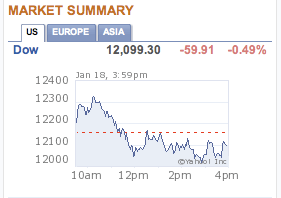

And one side note. The National Association of Realtors, the lovely lobbying organization designed to market buying and selling houses (as opposed to making sure everyone has housing) and ensuring one of our most regressive tax breaks stays in place, the mortgage interest expense deduction, is running ads advertising a rather misleading website. They make some ridiculous claims about the historical appreciation of houses, and of course, the data they cite is their own historical series survey that you have to buy from them. Obviously, the reason they don't cite the data is because it's based upon the height of the housing bubble, not the long-term historical record that shows houses appreciating about half a percent a year above the inflation rate, much less than the doubling every 10 years they claim (which requires over a 7% annual gain). Plus, of course, these are all gross figures; they are not net of the costs of homeownership. Homeownership is valuable mostly because people like owning their home. Few people treat their homes in the emotionless, rational state necessary to count as an investment.

But what really is offensive about the website is the use of statistics about the distribution of wealth. They accurately point out that homeowners as a group have a much higher net worth than renters. Having a net worth of "46 times that of a renter" is most definitely not a benefit of home ownership, though. It's a benefit of higher wages and a longer working career. In fact, their observation is precisely why we should eliminate the tax breaks for homeowners. People who earn money to buy and sell property obviously want you to think that owning a house is more valuable than renting one. But that doesn't mean it actually is, and it certainly should rouse suspicion and scrutiny when a lobbying organization is making such blatantly misleading statements at a time when the market it represents is in the bust phase of its bubble.

(P) I hadn't originally intended that little disgust with the NAR as a segue from the market's ups and downs to Senator Edwards' ups and downs, but it seems pretty appropriate. I was very excited yesterday to go see John speak at the Carpenter's District Council building. For one thing, I'd driven past it a hundred times, but I'd never been there. It's interesting living in a town that actually still has a union presence. It was also a reminder, that I say only half-jokingly, that lots of white people live in the city, too. It was almost unbelievable, I'd say 3/4 of the people who packed into that meeting hall were older than 40 and white. They still exist!

I really liked his stump speech, and that was really the first time I've been around a large gathering of Edwards supporters. Mostly it's been smaller groups, like what we did at Earth day or greeting him at the National Urban League conference. In my mind, Edwards is saying the right things and has the right approach.

Clearly, though, Nevada did not go very well yesterday for Edwards. It makes me wonder a bit if they started campaigning elsewhere because they knew that was going to happen. With two third place finishes in a row, it's worth asking what is left to get accomplished. While finishing third in the Republican race any given day isn't a big deal, the Democratic side is a little more consolidated at this point. That itself is quite interesting, since the corporate media likes to talk a lot about fractures in the Democratic party when the GOP is really what is splintered at the moment, but that's a slightly different topic.

What stands out to me is that there's no reason not to keep going. For one thing, Clinton has not been able to stake out a majority position, even as she borrows some of the ideas and language from the Edwards and Obama campaigns. She hasn't won a majority of delegates in any state so far (unless you count Michigan, which is actually embarrassing for how few votes she received), and in fact, Edwards beat her, at least in terms of votes, in the Iowa caucus (you don't really know for months the actual delegates each candidate will get). If Nevada is a sign of things to come, then obviously Edwards isn't stealing votes from Obama. If it was an aberration, then it can't be a reason to ask Edwards to leave the race. The longer he's in, the more he has a chance to shape the dialogue and influence the convention. And of course, he just might win a few states.

That leaves me with the most interesting question I have after this weekend. Why do some people want him to drop out? Do they not like his message? Do they think he's preventing Clinton from getting more votes? Do they think he's preventing Obama from getting more votes? Do they not like having a broader field to choose from? Does Edwards' continued presence allow him to raise uncomfortable questions that people in the media or the party don't want asked? If a majority of voters want Clinton or Obama to be their nominee, then I'll respect that. But what I don't understand is telling a guy he needs to drop out after only three states have voted, in one of which he beat Clinton.

I hope Edwards picks up some states in the next few weeks. But I'm quite sure it would beneficial for him to stay in the race through the convention, even if he doesn't win a single state.

7/19/2007

14k

I had to write about this milestone. It is an excellent time to remind that for long-term investing, a critical component should include equity markets.


However, it is worth noting that the vast majority of these gains go to the richest people. The top ten percent control over 3/4 of the stock market. In contrast, the poorest half of the country control less than 2 percent.

If those kinds of numbers don't move ya, well, I guess you're just not moved by numbers.